Tag Archives: safety

IOM Worlds : Scoring, Backing Up Your Data….!

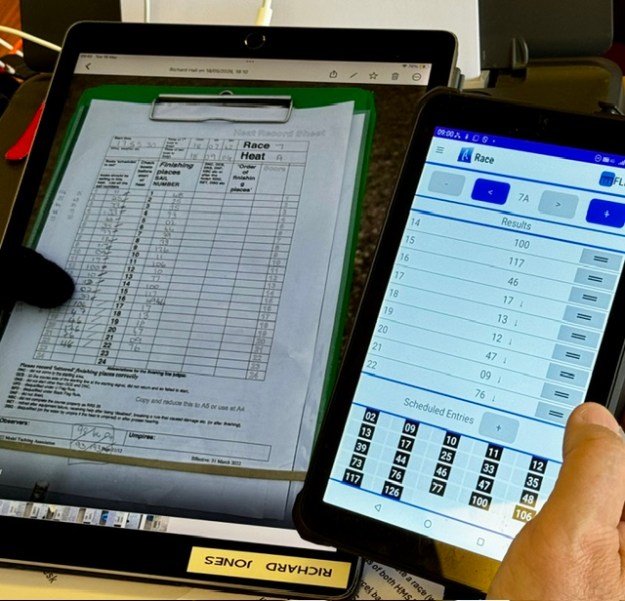
(A4 sized iPad Pro receiving score sheets fromThe Finish Line. Note this means you automatically have backup images of all your heat score sheets as they come in. Safely stored in your WhatsApp group.)

You cannot get half way through the Worlds, then lose all your data.

It maybe will surprise the uninitiated path you maybe spend more time “backing up” than you do entering scores. It’s a big deal.

We held three levels of race data:-

1/ On USB sticks (double ended USB-C and USB2, so you can plug into just about anything), we had our Current Data. Keep this folder neatly filed inside subfolders as you go.

2/ On the hard disk of our HMS primary lap top, we held our first level of data backup.

3/ The hard disk would automatically back up (if MS Cloud was working!) into OneDrive. All scorers and Officers were authorised to access the cloud folders.

We had two times that we did backup processing.

1/ At the end of every heat (so about 3x an hour) we would backup the three device layers above, being very strict about naming conventions. (more on that later)

2/ At the end of every race, as A heat had been entered, we would send a set of backups out via email to all the scorers and Officers in case of a proper disaster.

Naming Conventions :-

As we had different scorers on data entry duty each session , it was important that we all used the same naming convention and backup routine. We used a great concept from Andrew Crocker who was the Scorer at Gladstone.

  • the current heart was always named “current heat” and not by its heat number.
  • as we saved the backup, it would be named “heat 3b” , for heat b race 3 for example –the same in all layers of storage.
  • for extra security against gremlins, we wanted to build in a fresh close/reopen of excel as we proceeded.

Were found the quickest most foolproof way for heat backups was

1/ While in “current heat” , hit the little purple diskette icon (“save”) at the top of the excel spreadsheet

2/ Select “save as” and change the name from. “current heat” to “backup heat Nx” eg 3a, as you go. Save in the USB, and then on the hard disk.

3/ At this point your live spreadsheet is called “backup R3d” for example. Not what you want, so CLOSE excel completely and then go and find “current Heat” and re-open it. You are now ready to score again with a hopefully fresh excel.

If it is the end of a race (end of heat A), do all that, then email via outlook your “backup heat Nx” file to a list of the scorers and Officers. Your disaster copy – that should be your “Get Out of Jail” card if everything blew up.

A Small Improvement in Battery Storage….!!

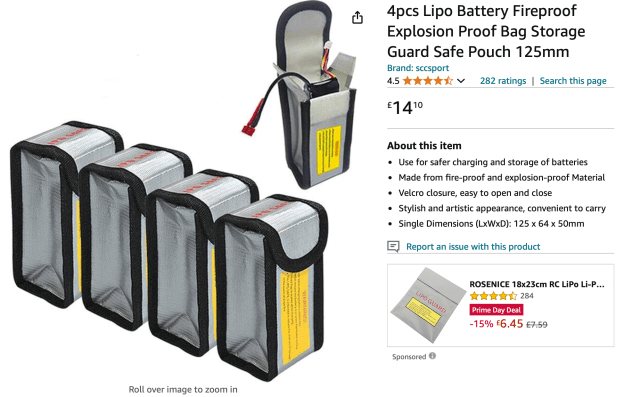
Nigel B recently showed me a very neat little battery bag you get from amazon.

Actually you buy them in bags of four at an embarrassingly low price. You can get two or three 2-cell LIPOs or LIFEs in there easily.

I’ve been wanting to neaten up and smarten up my battery storage recently. These things are ideal, because of the outer bag that I use.

It keeps all the batteries in neat little pockets so that during race day it is much easier to remember where you are with power supplies. I reckon I could get another four little bags and then easily store 8 of them inside my outer bag. Very neat and tidy.

All inside this single outer bag. You could easily store 20-24 batteries in there very neatly, bagged boy connector type maybe.

Thank you, Nigel!! This was the Amazon page…. £14 for four.

Batteries for Beginners – One !!

Around Christmas time, SM suggested that I write some entries here about batteries and electric power. It’s a little daunting, as I suspect SM knows more about this than I do… but here goes…

Mostly I want to write about four things

  • Batteries, identifiers….LIPO v LIFE, safety and all that
  • In-boat connectors
  • Battery Damage causes
  • Charging

It won’t be long after you start radio sailing that somebody starts chatting to you about batteries and especially about the LIPO v LIFE debate. There’s loads of other topics in the same area that divide opinion too.

Let’s start about the batteries though. There will be other materials available inside the batteries, but in the main, in radio sailing we need rechargeables, and either LIPO or LIFE type. As far as I can see, they need their own charging regimes but more of that later.

Before any of us went radio sailing, we would look for two things on the outside of a battery that normal humans buy in Tesco

– the physical size represented by a code like AA or AAA or C2032

– the voltage

The is hilariously misleading for radio sailing because firstly the physical size and shape doesn’t seem to have a code at all , as far as I can see. They vary a lot. They sometimes but not always tell you how many cells are in there. Second, all mine have the voltage on like 6.6v or 7.4v… but when you charge them up they always accept more than this voltage. Baffling, but I set it aside. It’s a guideline.

The other number which could be interesting, that is how much sustained current you can pull out of them measured in amps. Like some kind of measure of how fast you can pump petrol out of a car’s tank – something like that. I think the principle is that LIPO can deliver higher amps than LIFE can. This number is not written on the outside of any of my batteries, but we shall return to its importance in a later news post.

I thought with electric cars the best advice is keep the engine charged between 10% and 80%. By the way, at east two of my little instruction sheets for my sailing batteries say to recharge them at 50% of the nominal voltage. I’m trying to stick by that.

The battery material type should be written on the outside, else how would you know what charging regime you need. At least two of my batteries do not say what’s inside, though I know they are LIPO. I might have to put my own labels on!

Have you ever looked on google or YouTube using the search term “battery fire”? Not to pick on Tesla cars, but quite a few of those come up. I feel they are being picked on unfairly! Well, anyway, that basically is what the radio sailing chatter can be about too – LIPOs have a reputation for fire damage. When I acquired three LIPO batteries for the IOM they came in a fire proof bag…. for heaven’s sake. Allegedly, LIFE batteries are safer in that regard.

I thought it was all over played, then the very first expert I asked about it at the Club said, “oh yes – I’ve had some catch fire”. I was stunned. So, to form a better opinion I decided to buy both types and see how they perform. I keep mine in a fire proof bag and I keep that inside an explosion-proof bag. Honestly. More on that later, but the bags are cheap enough and I want to stay married.

Of the numbers stamped on the batteries (my battery collection has two to four numbers stamped on the outside), the ones to look at are (i) voltage – searching for analogies, but think of it as a bit like octane in petrol. It is some kind of expression of power – but firstly all mine charge a tad higher than labelled, and the voltage available anyway changes constantly during your sailing day. (ii) the next number you want is m.a.h. – milliamp hours. It is kind of a measure of how much petrol you have in the car tank. Sail gently and the battery lasts longer, adjust the controls more and you battery lasts less time on the water. It’s how much total energy you allegedly have on board.

More to follow….