Well, for Dinghy/Keelboat and Radio Sailing Club Racing and local Club Members it looks as if we could be back in business!!
Probably too restrictive for Open Meetings, Championships etc (to be evaluated and confirmed) it looks like we could be back to club sailing. When viewed from the Clubhouse end, the water level looks dire. However, it’s a big lake – about the size of 300 football pitches. Three miles around the edge, remember. Radio sailing needs only half a football pitch and a metre of depth!!
So last Wednesday, our Commodore and Sailing Sec leapt in the car to examine the view from the “far end”. Amazingly, 1.4 miles from the Clubhouse they found flat-ish concrete slabs almost unadorned by Thames Water Silt !!! Look at the acreage of water when viewed from there!
In next to no time, they had a digger down that end, clearing a wide path for dinghy, keelboat and radio sailing launching. There are even ancient mooring blocks over there to which we can moor a short temporary launching platform. Amazing! A fabulous job, especially in that heatwave.
“Depth?” did I hear you ask?? Well, we could get Marbleheads in at the end of that little “ten cube long” pontoon – off the end… each side was more hazardous. A few more deck-cubes of length, which the Keelboat fleet might like, would make all the difference.
The K1 keelboats’s had a team of four to evaluate the launching viability, including the Class UK Chairman plus DWSC ex-commodore Mike B …. the great news is that they are keen to “go” as well.
We think the depth out there is generally 3-7 metres. By Sunday morning, our Radio Sailing Sec and Commodore had already done an amazing job laying some radio sailing marks. We had six Marbleheads this morning (4mph of tiny whispy breeze), and WE WENT SAILING!!
So it’s going to see us through to winter, we reckon. Obviously a fair old drive over there, no structure (gazebo maybe possible) but plenty of flat parking space. The Club Manager is talking of getting the digger in there again to clear some more. They have a huge broom system that the tractor can tow.
Just brilliant news!!
Thames Water are being very supportive – just so long as the dinghy/.keelboat fleet obey an exclusion zone around the pumping pier. No problem for radio sailing. Cars are being temporarily permitted, but not portaloos. So plan ahead !! Eat and drink lots at the Clubhouse to support our Galley team. (lunch was great today!)
Have you popped in to the Club in recent days? The Landlord has taken a lot of the water. The “word” is that they have permission to pump out if they want up to next Wednesday 12th August. It has gone down bit in the last 24 hours – the reservoir is very flat at the bottom of course (like a bath!) so a one metre drop tends to expose many meters of new beach.
Having been a member for 30 years, I must say that each time it gets drained (maybe seven to eight times in my tenure?) it tends to look very different. In the early years, there was hardly any silt and we had some great racing at water levels the same as now, launching off the South beach.
You just cannot tell what the silt layer of the year will look until it pumps out. Commodore Phil, just last Thursday, was very optimistic we could get good racing in. Not this morning though.
Craig was the member to do God’s Bidding today, and test the depth for IOMs. By the way, he drove his car a long way around the lake looking for a more optimistic spot, but none was obvious.
There were 13 pallets from the shore to the pontoon – 24 hours ago I’m told it was only three pallets.
Craig still had to wade the last metre or two in his wellies – silt and mud beneath.
Craig then pulled the pontoon around to be more perpendicular to the shore (70 degrees to the shore maybe) and then ta-da … enough depth!!
That’s Craig indicating how much depth was out there!!
Realistically we have to wait until the level stabilises to assess if there is a way for Club Racing to resume…. if it stayed at today’s level (unlikely?) there might be a clever and ingenious way to rig a pontoon (currently split in two sections) perpendicular to the shore – using a tractor perhaps. However, until the water level stabilises it’s not worth doing any physical work on it.
The K1 keelboat fleet were of a mind this morning that they couldn’t cope with the situation as it was today. But if they can figure a way, it would probably suit radio sailors as well.
A dynamic situation – we shall see.
Craig again – the Proteus is just hiding behind the orange rib if you look closely.
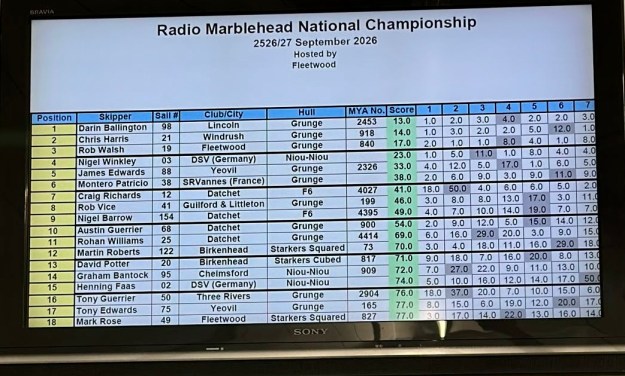
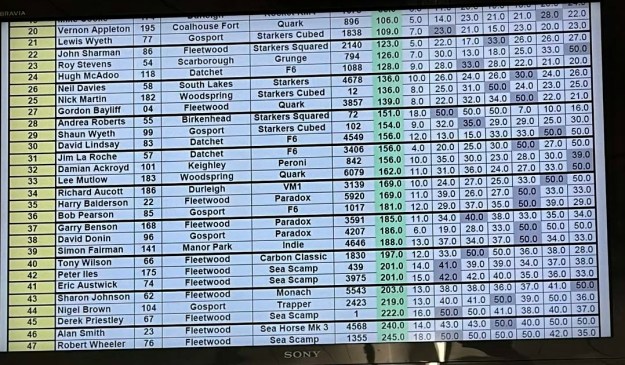
Running up to the IOM Worlds, the subject of SHRS race formats did come up in conversation a few times. Since the IOM Worlds, unexpectedly it has been mentioned a lot more. There have been three broad topic areas:-
enabling larger fleets brings bigger entrant fee income, and large championships are VERY expensive to run
SHRS is less prone to Protest linked regatta delays or pauses in racing. I must say, the Worlds were much more “protesty” than I have experienced before. A good concern to have.
intriguingly, this months hot topic has been blending SHRS and HMS together in one event
Reflections based on the Datchet IOM Worlds experience?
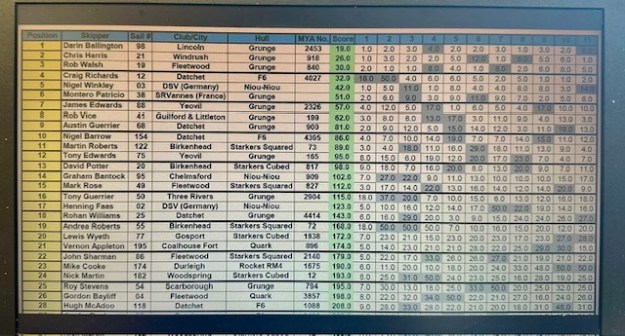
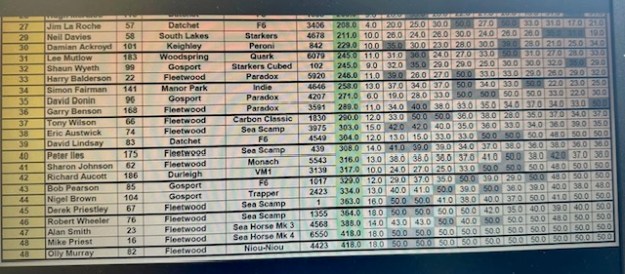
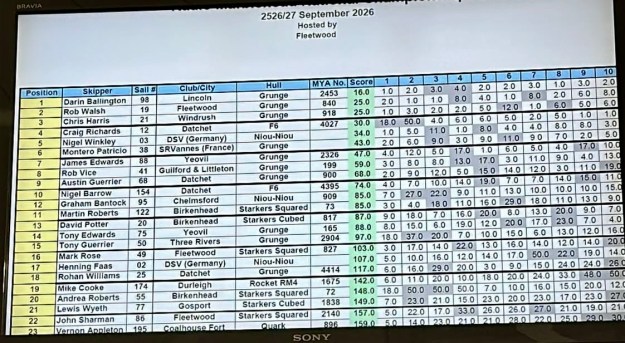
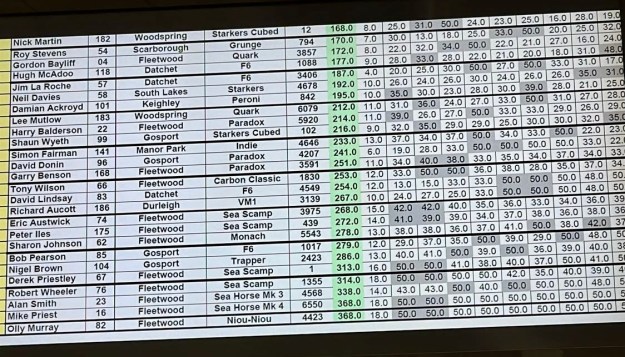
First off, I wish we at Datchet had real live experience of organising and running an SHRS event. It’s great that we have three race formats (single heat, multi heat HMS and SHRS) available and the management tools that go with them. Brilliant, actually. The sailing sport faces a wide set of outcomes that it might want to address. We need choice! It’s unlikely, especially radio sailing’s high volume, sprint race kind of format, that one tool could do everything. So choice is good!
Quite often it has been said to me that SHRS will be great when the entrants fly in and are basically captive for the week. Everybody stays to the end, right? If your Championship event entails competitors driving through national traffic,…. if competitors don’t feel engaged on the final day ….. do they withdraw and leave early? You bet. Is that just Brits who do that? I don’t know! (From a personal viewpoint, for 60 years people not staying to applaud their own winners at the prize-giving has disappointed me in the extreme. But it happens…)
Maybe the way to look at it would be SHRS for “fly in” championships and HMS for “drive in” championships. If you have a view, write into the website and let us know.
Let me deal with the three common questions arising above:-
1/ Fee Income goes up with SHRS
Let’s suppose you have enough demand for a 100 boat regatta, way above 84 boats. Call it 20% more.
There’s no point thinking this is the Holy Grail for Regatta cost coverage. At the IOM Worlds, we saw half to three quarters of the basic entrant fee income being absorbed by costs as a direct function of the number if entrants. If you’re chasing a financial surplus, or simply trying to avoid financial ruin, then you might think more than twice about SHRS bringing salvation.
2/ HMS brings race pauses and regatta delays from Protest Management
Well, this needs a good look at really. This was my first personal experience of a fully umpired event. we had many more protests relative to a UK focussed event, and the general level of rule observance was possibly a weeny bit controversial.
Inevitably you will wonder how many umpires have to hear a single protest to reach a decision. As you may know, in HMS racing we have historically avoided Standard Redress awards as the scoring software in HMS Excel has no support for it. It’s awful without as it’s manual calculations all the way. What if Standard Redress scoring was fully automated?? If Umpires thought they had a free hand to distribute Standard Redress awards, could it make non-SYRPH protest hearings shorter? Afleet’s standard redress support is kinda of 95% automated already, but what if all our scoring platforms had a 100% fully automated Standard Redress capability? Could the Umpires use that confidence to use these awards to try and shorten hearings?
3/ Blended SHRS and HMS Events
The first time I eavesdropped one of these conversations, I wasn’t sure what was being suggested. It sounds like one or more of the European countries have an idea to run the first three days of a large championship on SHRS, then at the great SHRS split of the fleets jump into HMS heat based racing to keep engagement high for the last couple of days. What do you think of that?? (let us know)
It’s interesting, but a couple of quick thoughts from us:-
if you have taken the opportunity presented by SHRS to boost your number of entries above 84 boats, how to you transition perhaps a 95 boat fleet into HMS for the last two days??
One answer may be to enhance HMS Excel, but you may find it useful to know that AFleet has been tested at the 96 boat level. Interesting.
at the end of the SHRS phase, do you simply load scoring on an HMS system using the current “position” like a ranking table?? Maybe that would be fine.
We cannot physically expect PRO and competitors to manage more than 22 boats concurrently on the line. Good point, but what’s involved in lifting the maximum number of heats from five to six? It might be easy-ish to do in Excel, and Afleet could do it easily if asked.
The HMS Rule book schedules A&B for determining heat-based fleet structures/sizes don’t go high enough. Well, not difficult probably to write some more schedules, and in Afleet at least the heat sizings are done by an algorithm, not by table lookup. The algorithm can could handle larger fleets than 84 or more heats per race than 5…..
If a venue could support heats above 22 for some reason (eg control area location), what about the “promotion setting” choices moving from 4 or 6, to a 4-6-7 type choice? Could be written for Excel and for Afleet it’s not a big deal. There will be some choice of race pattern where a competitor gets more races in on HMS than SHRS?? I don’t know, but probably someone can write in and tell us !!
On any of these types of answers, first up you need to get the skilled volunteers you need to score the event. A large concern actually. By the way, there is more than one camp looking at providing a scoring platform that deals with HMS heat based racing AND SHRS based racing inside the same scoring system. That might make finding skilled volunteers a little easier……