Tag Archives: travel

Receiver Range Test Comparison – Radiomaster ELRS versus Futaba with Antenna Frame (from SailsEtc)

We have had lots of Club chatter over the months/years about radio range, losing signal to the boat and so on… the merits of different transmitter brands etc. Remember, you can lose radio contact with the boat for SO many reasons.

You’ll all know that Flyers in free sky find they get simply massive radio range and quote exciting numbers stated in whole kilometres – 10 km not being unusual.

What range do we need in radio sailing? 100m maximum I should think. Nonetheless, “who gives the strongest signal and furthest range” continues to intrigue us.

We have had Club members trialling ceramic antenna based receivers (no dangly wires) from Spektrum and Radiomaster ELRS. These dinky little receivers are great in a sailboat “pot” with zero wires from a space management viewpoint. They were though designed/optimised for indoor car racing – all very different. The Futaba equivalent wire-free receiver actually states a maximum 70m range, so I’ve not bothered to test it.

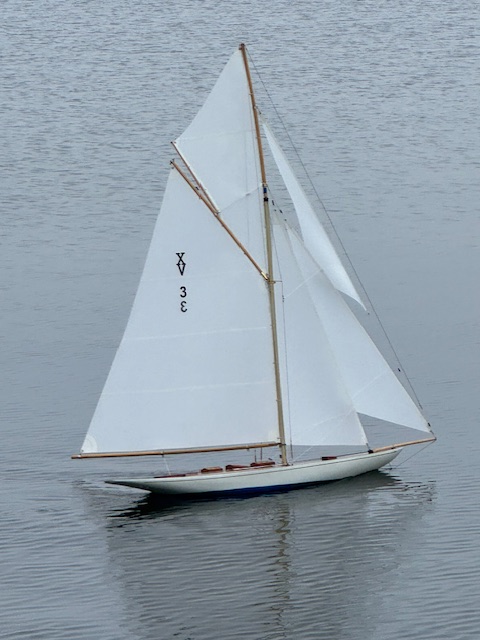
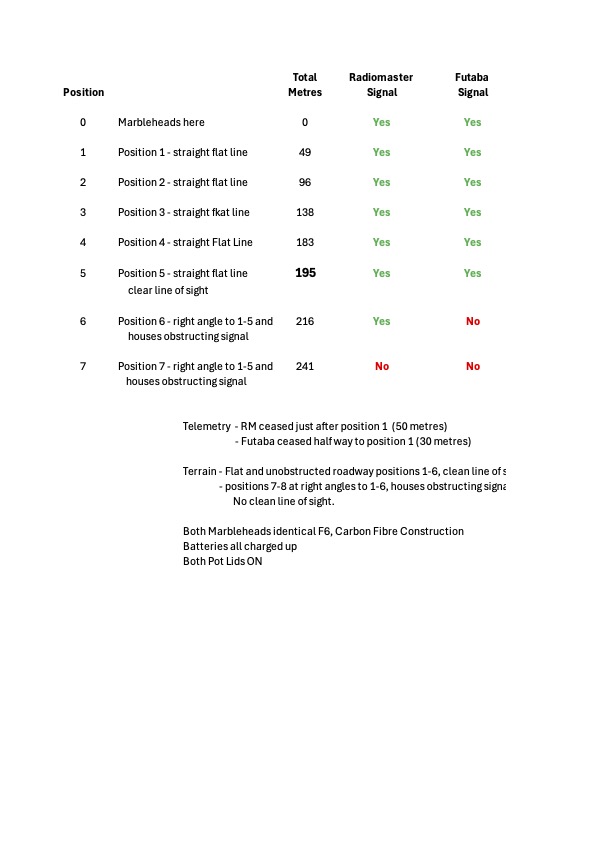
A unique combination of circumstances came up this morning. Two identical, carbon fibre hulled F6 Marbleheads, one with Radiomaster TX15 and ELRS (ER3Creceiver). The other rigged with Futaba T10J and their cable antenna F3006SB receiver…. fitted in a SailsEtc antenna frame that tucks it neatly at the pot top,… wires at 90 degrees as recommended by Futaba. …Plus no rain!! …Plus a spouse who was willing to help by watching boats out of the kitchen window (very rare treat!). All batteries were fully and equally charged. Transmitter power/strength settings, transmission packet rate, were as they were to-of-the-box and new.

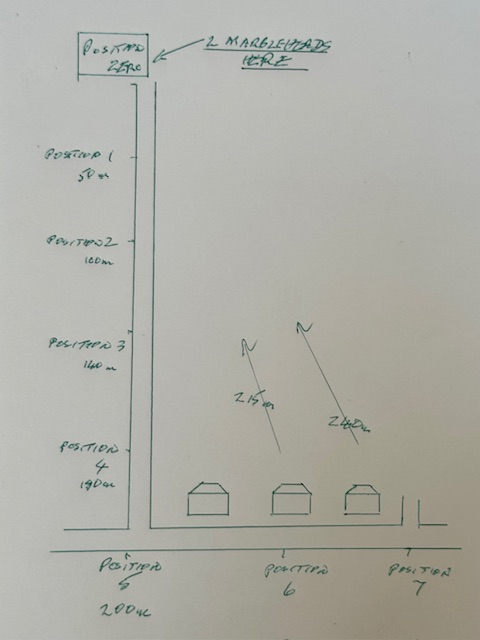
We sail on dead flat reservoir water, so with a solid surface beneath us, not free sky. Clear line of sight to the boats, no obstructions. Today’s tests, Positions 0-5, were similar really – carried out on a dead flat street, 200metres long, with line of sight to the boats. Then the next two measurement points I had to turn 90 degrees at the the road junction and walk along that street (measurement points 6 and 7). Measurement points 6 and 7 therefore lost line of sight, and gained a couple of houses in the way of the signal…. they were quickly more challenging to the radio, but I wanted to see which brand gave up first, and was it actually a “close thing”?? Measurements stated for position 6 and 7 were direct back to position 0, as the bird flies.

Measurements were taken via What3Words and a website named grid reference finder.

Conclusions

  1. Nearly exactly the same range for Radiomaster ELRS and Futaba, around 200m. Easily enough for radio sailors and probably double what we might usually need.
  2. Radiomaster lasted maybe 10% further (20m) than the Futaba.
  3. Both lost signal by 240m. (Needs to be tested in a straight line at the reservoir.)
  4. Despite being an indoor wire-free receiver, the RM ERC3i unit performed very well against the Futaba.
  5. If I had patience I would test the Futaba again without the antenna frame. It would be interesting to see if dangling free wires into the pot (carbon fibre hull remember) makes any real impact on range.
  6. Telemetry range was disappointing in both cases. Radiomaster gave up at around 50-60metres. Futaba lost telemetry signals at around 30metres. I believe the flying community call it “Fly By Telemetry”.
  7. Good job we radio sailors are not interested in ranges of 10km away. No chance….

Wind-Focussed Weather Apps….!!

We will all have our favourite weather app, won’t we?

Do you find that you look at more than one weather app to judge what the wind is going to be at your sailing venue? What rig shall we go out on?? Well, this article is aimed at you !!

I recall a few weeks ago at Datchet, Rob V telling me he had abandoned the BBC App as it was simply never right!! I have huge sympathy for that … but some days it does seem to be correct 🙂

Many years ago, we used to have an anemometer at the top of the slipway which told us exactly what was happening there at the moment, but there again it gave you a reading – not a forecast. Chipstead SC have a smashing online weather station at the side of the lake… but there again it’s not in the middle of the lake!! So what to do??

During lockdown, the main Datchet Club ran a Members’ Zoom tutorial on this subject. It turns out we have a meteorologist member in the main Club who hosted the session. Extremely interesting, it was.

Did you know that the world of weather forecasting is basically a wholesale-retail model? At the wholesale level, which is where all the data comes from, there are really only half a dozen suppliers of weather data worldwide. I think we were told that for using truly global data there are only two suppliers. These suppliers are currently at the level predicting wind in a 1km grid section… and trying get even finer resolution. Huge compute power is the limiting factor.

The other suppliers are basically the lower cost alternatives. As I recall, UK Met Office is one of the big players. You may recall a kerfuffle a few years ago when the BBC decided to stop using the Met Office data and signed with someone cheaper.

A friend has recently completed an RYA Advanced Race Officer course. The chatter there was an about a weather app called “Predict Wind”. Have you seen it? I’m using the free version, but the key thing is that you get to see all the wholesale layer of information on one screen – and you can make up your own mind what the breeze will be.

(this morning’s data above…)

I like to view average speed, direction and the expected gust speed. The photo above shows you the screen I use for this. Average speed at the top, then direction and gust predictions below that. You can just see the top three rows of the gust forecast and have to scroll down to see the rest.

Each row you can see is labelled P, G, U, A, S etc. I think this indicates the wholesale source of the wind data. Someone like the BBC or Apple will use just one of those rows that you can see. In fact if you look at the BBC app and Predict Wind simultaneously, you can work out which one it is.

Even on the morning of the forecast (the screenshot above is for this morning…), you can see how much forecaster opinion varies, but at least when you see them all together you can make a few decisions of your own. Some days, they all agree, then you really know what’s coming !!

Give it a try and let us know what you think!

Marblehead Hull Bags….!!

How do you protect your hull when it’s in the car boot ? Or elsewhere?

When I started with a loan IOM boat, I simply lined the car boot with old towels and travelled around like that. To be honest, it only needs a sharp dab on the car brakes and things can get a bit out of hand back there.

When I received my One Metre, the builder said not to keep taking the fin on and off – so I ordered one of those One Metre Onesie bags from David Potter – see the category named “Transporting the Boat” on this website. I’ve come to quite like that bag, but I have to remember to remove the bulb cover before sliding it in. It all feels very safe and well protected.

By contrast, transporting the Marblehead is somewhat more challenging due to increased dimensions. David Potter does supply a Onesie bag for that job, but as the fin is 55cms below the hull, most people I think, remove the fin for travelling ….. leaving the rudder in place.

For a year or so I have been using the (lovely) lower bag for the Marblehead. Albeit with the rudder sticking out at the end, but it’s still fabulous. All soft and snug! You could sleep in a human size version. It has an adjustable strap and buckle for the enclosure.

Rudder protection does worry me though – our member Richard U designed a new bag with a simple drop down section for rudder protection – the top bag in the photo. It has a velcro strip for sealing the enclosure. Nice – I’d hazard a guess that the same design will take a Ten Rater too. The first couple of car trips using this have been very promising.

So now I have two bags…. question … “what is the ideal number of Marbleheads to own?”

“N+1….. where N is the current number that you have…”

The lovely bags are available at K7yachts or you can contact us vis the email address on the CONTACT page of this website.