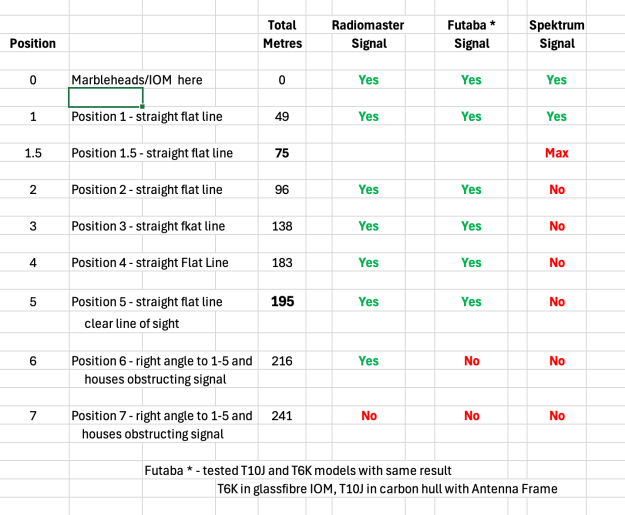
This is a no news item in reality!!! It seems that a Futaba is a Futaba as far as range is concerned. I thought we might see a difference as the T6K is distinctly older tech than the T10J.
This morning I ran up the T6K Futaba with R3006SB Receiver in a glassfibre hull (IOM) with the lid on …. in the same position as all the other tests.
Within about a metre, the T6K/R3006 radio gave identical range to the T10J/R3006 – in the same league as Radiomaster TX15 with a ceramic aerial ER3Ci Receiver. On a straight line of sight, you can go a jolly long way. Let’s call it 200 metres.
As the boat today was a glass fibre IOM (K2) there was no need for an antenna frame – the beautiful SailboatRC pot has threading holes to position the antennae appropriately.
How far away can we see race marks, start line situations and sail numbers? Not far.
I’ve just had a bit of a shock though. You may remember that I have a horizontal, dead straight, line-of-sight, transmitter range test based in the street where I live.
I recently put Radiomaster and Futaba through the exact same test and basically got a radio range of around 200 metres for both of them. Blimey.
Radiomaster just a tad more maybe, but I ran out of straight street and had to go round the corner. That is way more than we need in radio sailing.. I can hardly walk THAT far.
You can read my recent range comparison for Radiomaster and Futaba here:-
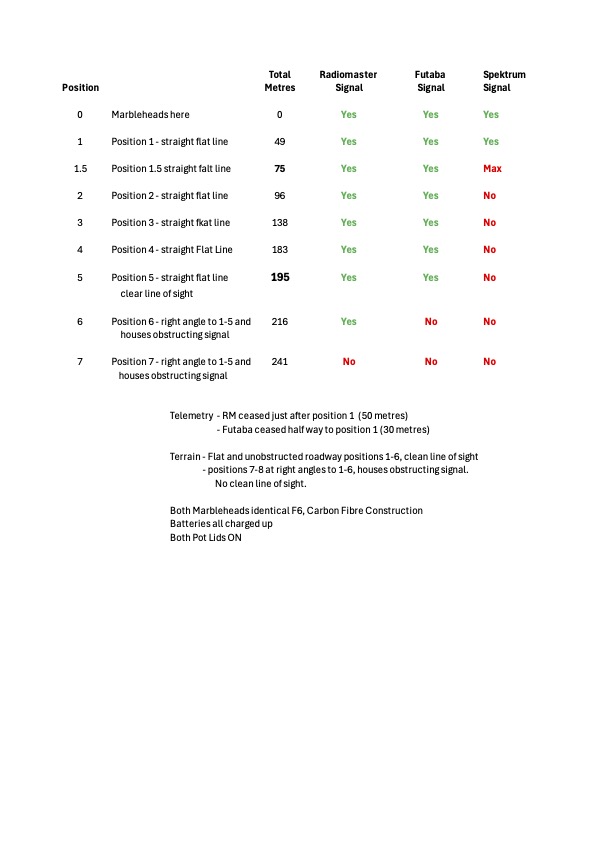
Tests conducted by RC Flyers in the USA suggested that Spektrum only reached maybe a quarter to half the distance of Radiomaster/ELRS. I was curious to test my DX8e against it. I am just starting to prepare the Datchet Radio Sailors’ online manual for Spektrum. I thought I’d put my own lovely Spektrum DX8/AR620 through the same range test, using the same boat…. before I start the programming and manual writing.
I’m a bit stunned. At first, I thought it must be low battery power, and so changed all the batteries for fresh ones. Same result. So my next thought,… after swearing,… was “faulty transmitter”…. (you might say!!) …. but I’ve had this particular DX8 range tested and a fix applied at the Spektrum UK distributor, and it passed their tests just fine after that.
You might be thinking that it was caused by the smart but tiny, and wire free, ceramic antenna of the AR620 receiver. Maybe. Lovely kit though.
But the Radiomaster in this test also used a ceramic antenna in its ERC3i – even more weeny and more tiny that is. It’s so small, you’d be inclined to try and wipe it off the hull in case it’s a speck of mud.
The AR620 is about twice the physical size of the ER3Ci. When I get the time, I’ll re-test the Futabas without the SailsEtc antenna frame … just dangling wires in the pot … to be disproved, but I personally suspect the antenna frame (called “aerial holder” at SailsEtc’s website) is a big factor in this test.
I’m reluctant to trot down to TJD Models and buy a wire-antenna Spektrum receiver, as I’ve seen an official Spektrum video claiming that the ceramic antenna has better range.
But – well, how much do we need in radio sailing? I’d personally have difficulty racing 75 metres away – it’s surprising how far that is. I know a number of radio sailors who simply adore their Spektrums… but for myself, I’m still surprised by this test result. The guys at Datchet want me to test a FlySky over the same street. I’ll do that as soon as it’s practical – I no longer have a FlySky here, but I know where to get a loaner.
The article showing the results of the USA flyers can be found here:-
We have had lots of Club chatter over the months/years about radio range, losing signal to the boat and so on… the merits of different transmitter brands etc. Remember, you can lose radio contact with the boat for SO many reasons.
You’ll all know that Flyers in free sky find they get simply massive radio range and quote exciting numbers stated in whole kilometres – 10 km not being unusual.
What range do we need in radio sailing? 100m maximum I should think. Nonetheless, “who gives the strongest signal and furthest range” continues to intrigue us.
We have had Club members trialling ceramic antenna based receivers (no dangly wires) from Spektrum and Radiomaster ELRS. These dinky little receivers are great in a sailboat “pot” with zero wires from a space management viewpoint. They were though designed/optimised for indoor car racing – all very different. The Futaba equivalent wire-free receiver actually states a maximum 70m range, so I’ve not bothered to test it.
A unique combination of circumstances came up this morning. Two identical, carbon fibre hulled F6 Marbleheads, one with Radiomaster TX15 and ELRS (ER3Creceiver). The other rigged with Futaba T10J and their cable antenna F3006SB receiver…. fitted in a SailsEtc antenna frame that tucks it neatly at the pot top,… wires at 90 degrees as recommended by Futaba. …Plus no rain!! …Plus a spouse who was willing to help by watching boats out of the kitchen window (very rare treat!). All batteries were fully and equally charged. Transmitter power/strength settings, transmission packet rate, were as they were to-of-the-box and new.
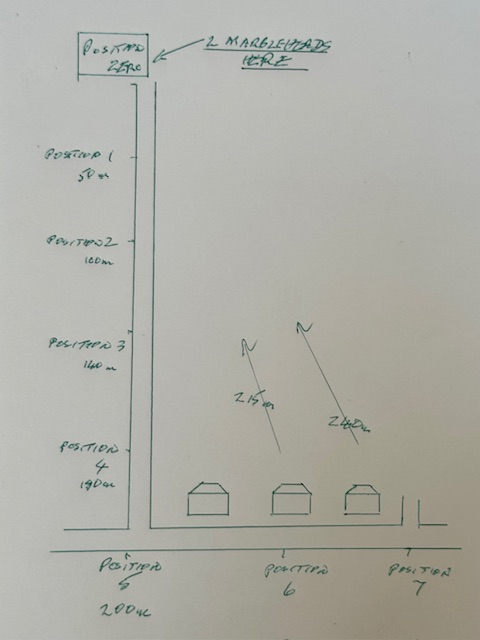
We sail on dead flat reservoir water, so with a solid surface beneath us, not free sky. Clear line of sight to the boats, no obstructions. Today’s tests, Positions 0-5, were similar really – carried out on a dead flat street, 200metres long, with line of sight to the boats. Then the next two measurement points I had to turn 90 degrees at the the road junction and walk along that street (measurement points 6 and 7). Measurement points 6 and 7 therefore lost line of sight, and gained a couple of houses in the way of the signal…. they were quickly more challenging to the radio, but I wanted to see which brand gave up first, and was it actually a “close thing”?? Measurements stated for position 6 and 7 were direct back to position 0, as the bird flies.
Measurements were taken via What3Words and a website named grid reference finder.
Conclusions
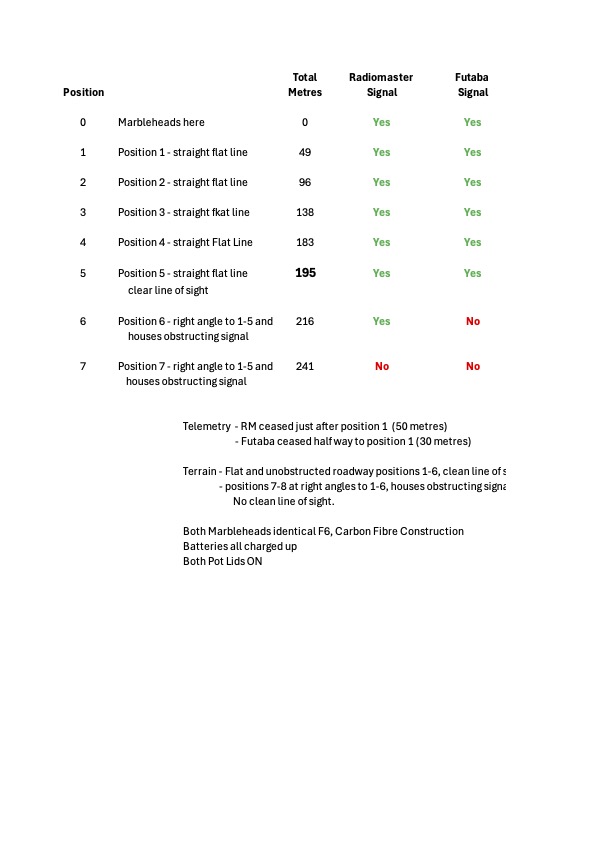
Nearly exactly the same range for Radiomaster ELRS and Futaba, around 200m. Easily enough for radio sailors and probably double what we might usually need.
Radiomaster lasted maybe 10% further (20m) than the Futaba.
Both lost signal by 240m. (Needs to be tested in a straight line at the reservoir.)
Despite being an indoor wire-free receiver, the RM ERC3i unit performed very well against the Futaba.
If I had patience I would test the Futaba again without the antenna frame. It would be interesting to see if dangling free wires into the pot (carbon fibre hull remember) makes any real impact on range.
Telemetry range was disappointing in both cases. Radiomaster gave up at around 50-60metres. Futaba lost telemetry signals at around 30metres. I believe the flying community call it “Fly By Telemetry”.
Good job we radio sailors are not interested in ranges of 10km away. No chance….