A competitor holding a Standard Redress Award will, …not unreasonably,… at some time towards the end of the event check the results table and see what points improvement he/she received in the impacted race.
Remember that Standard Redress awarded points can keep changing as future results arrive.
In the excitement of the moment, if it looks like the redress has not been applied per the Race Committee decision there’s going to be questions !!!!
However, not everyone will remember (experience speaking!) that before the redress is calculated and applied at the defined time, there is one final test to be completed…… “Is the awarded Redress score better/worse than the competitor scored in race itself.” The idea is that as the redress is a result that floats.changes over time, it may come out worse than the competitor actually scored.
In this case, the Scorer should not apply the redress.
TIP : the Scorer’s issue can become how to quickly show any competitor that Standard Redress has been considered but NOT applied because it failed the “BETTER/WORSE than” test. Our suggestion is that if the existing race score is to be left unchanged, it is actually entered in to the system with RDGfix, but at the same value as before. That way, a querying competitor can just quickly glance at the score table and see that the full redress test was applied – and not ask for it to be calculated all over again!!
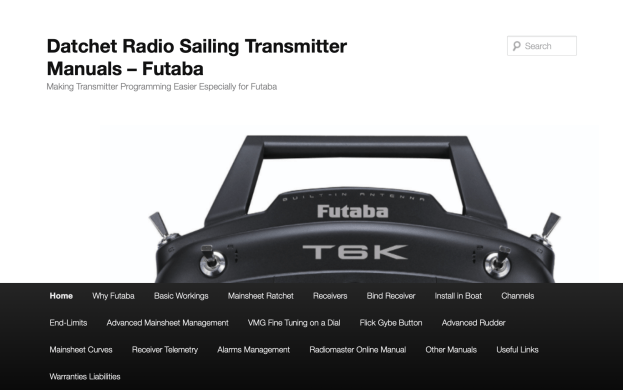
A lot of you clearly know about our downloadable collection of beginner radio sailors’ transmitter manuals. There have been around 2000 downloads now – we have FlySky, Futaba, Spektrum and Radiomaster in there. By the way, the Radiomaster manual on this list is by far the most popular. Given that we estimate there are only 19,000 radio sailors in the world (says AI !!), we think that 2000 download number is pretty interesting.
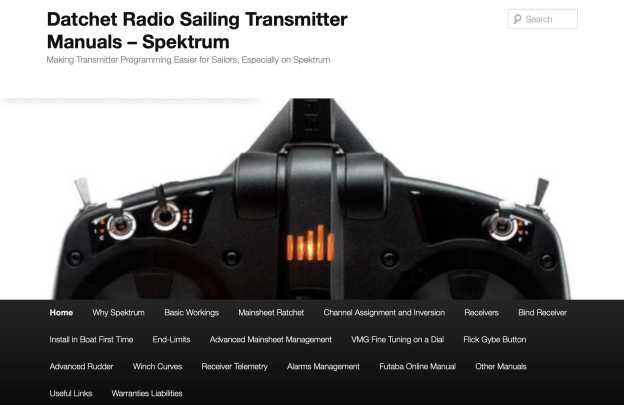
During the build up to the IOM Worlds, some mind boggling GBR talent put its mind to work to see if advanced features could be found on transmitters that would give the competitors a little competitive edge. The idea became to make three different radio sailing transmitter websites (Radiomaster, Futaba, Spektrum) and charge readers a nominal amount to subscribe to generate some income for the IOM Worlds.
A good idea… but we just ran out of runway and had a thousand other pieces of prep to complete. So we never got around to the monetised subscription idea. We’ve still got the manuals websites though.
For the basic radio sailors’ transmitter manuals, the easiest way to find them is to find the list of “Categories” on this website and select “Transmitter Manuals”. Alternatively use the website’s “Search” bar.
As to the three ‘advanced radio sailing transmitter’ websites, they are now online and available for free. To find them, just click on “RADIOS” on the menu bar of this website and you should find the three of them available there.
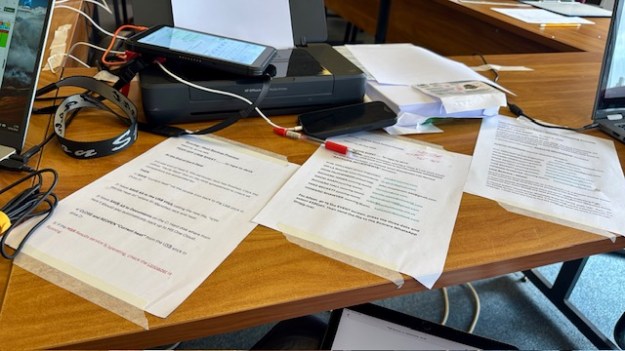
The photo above shows you our Scoring Team’s Process Crib Sheets. Note … taped to the desk (cleaners came every night), and angled in to the HMS Scorer position. We did a lot of preparation on “process” and we shall write about the importance of that in another article. There are three process sheets here:-
end of heat backups
end of race backups
end of race results publishing
There is of course one missing.
Standard Redress processing.
It’s missing because none of the Team, including me, understood in advance quite how important the work around Standard Redress was going to be. It’s massive.
It’s best tackled not at the end of the penultimate day… but in every race as you go through the Championship.
Most of us had never seen fully Umpired racing before. Interesting experience.
When the Umpires deliberate, a possible outcome is that an aggrieved party – knocked to the back of the fleet perhaps – can be awarded a “Standard Redress”. It is widely acknowledged by the Umpires that the HMS Excel scoring system does not have support for Standard Redress. This type of redress includes future score averages in races after the redress was awarded. It will be a manual calculation for the Scorers to complete after the last race of the penultimate day (look up on google or IOMWorlds2026 Jury Notice 1 for the Worlds). Redress awards given on the final day can use the standard HMS Excel button for “RDGave”. HMS Excel calculates redress awards looking backwards only – not into the future.
In UK, where use of HMS Excel is the norm, as there is no tool for Standard Redress we have a tendency not to use it. At the IOM Nationals we processed one. I’d not seen one before.
To be honest, it’s a very manual and error prone calculation. Get your calculator out and try one.
At the Worlds, after three days the Umpires had awarded three standard redresses. Concerned about what this would mean for workload at the end of the penultimate day:-
racing ends around 1830
scoring completes and winds down about 1900
1-2 hours of standard redresses to calculate, check, check again and then apply to HMS Excel
drive home (1-2 hours)
eat main meal of the day
go to bed
get up at 5am and do it all over again
… so I emailed the Umpires to “alert them to Scorer’s concerns as to the viability” of averaging one Standard Redress per day.
In the next two days of racing the Umpires awarded another 7 Standard Redresses. So we had 11 in total, two of them with one competitor. I had brought my Casio calculator and a ruler just in case….
Essentially for 12% of the fleet, you pop them into a boutique scoring system of their own. We had to separately hand calculate special scores based on ALL heats to date, check the rounding to 0.05, remembering which scores to exclude. (a competitor with two awards is a trap!) Then you have to apply the WORSE/BETTER score test to each Redress … then decide whether to apply to or not …. then load the answers into HMS.
Then ….publish race results to competitors so they knew exactly where they stood going in for the final day.
If you’ve read this far, you’ll understand the Scorer’s alarm.
So what did we do??
In flight, we designed, built, tested and used our own Standard Redress tool in Excel on our fourth laptop. We kept it up to date as Umpire decisions arrived, and race by race. At this award rate, no alternative really.
You can download our Standard Redress tool here on this link.
You are welcome to use it. If you discover an error, honestly… don’t tell me.
Points to note:-
every skipper with an award is tracked through the entire regatta, race by race
when you get an award in race N, you have to dig out all the scores in Race(1-(N-1))
watch out for the result exclusions
a skipper can have more than one award (see CRO33) and you have to cope with that
rounding needs to be watched
BETTER/WORSE Test needs to be applied
There’s a lot of calculating in there and you will see for each competitor, we ran the BETTER/WORSE test manually.
Before you load these Redresses into HMS, you need to audit them carefully. There would be hell to pay if one of them was wrong – Race Team protested etc. So how to do that audit?? The Casio Calculator??
You will note in the spreadsheet that each awarded competitor was audited (checked) by AFleet. AFleet happily has a Standard Redress button and we used it to check the answers our new tool was producing. You will see them there coloured black. Only when everything agreed, did we release the calculations for processing. Did AFleet find an error in the spreadsheet?? Yes – one. It might otherwise have snuck through undetected. But we found it.
Thank heavens for Parallel Scoring, eh??
Funny side-story :
This was a feverish work session and the whole team was ultra-focussed on their own contribution. Intense, it was. We hammered through all the processing and safely got the correct double checked answers keyed back into HMS Excel. Then I said to the Afleet scorer, “OK that’s done. Let’s do the same on the AFleet results now.” My colleague looked at me blankly and replied, “No … I finished all that ages ago….”
It built a little tension into the Umpire-Scorer relationship, I can tell you. In a very kind gesture, the Umpires presented us with gin and fruit cake. They were OK guys after all !!!