
Tag Archives: HMS

Reflections : SHRS and HMS….!!

Running up to the IOM Worlds, the subject of SHRS race formats did come up in conversation a few times. Since the IOM Worlds, unexpectedly it has been mentioned a lot more. There have been three broad topic areas:-

  • enabling larger fleets brings bigger entrant fee income, and large championships are VERY expensive to run
  • SHRS is less prone to Protest linked regatta delays or pauses in racing. I must say, the Worlds were much more “protesty” than I have experienced before. A good concern to have.
  • intriguingly, this months hot topic has been blending SHRS and HMS together in one event

Reflections based on the Datchet IOM Worlds experience?

First off, I wish we at Datchet had real live experience of organising and running an SHRS event. It’s great that we have three race formats (single heat, multi heat HMS and SHRS) available and the management tools that go with them. Brilliant, actually. The sailing sport faces a wide set of outcomes that it might want to address. We need choice! It’s unlikely, especially radio sailing’s high volume, sprint race kind of format, that one tool could do everything. So choice is good!

Quite often it has been said to me that SHRS will be great when the entrants fly in and are basically captive for the week. Everybody stays to the end, right? If your Championship event entails competitors driving through national traffic,…. if competitors don’t feel engaged on the final day ….. do they withdraw and leave early? You bet. Is that just Brits who do that? I don’t know! (From a personal viewpoint, for 60 years people not staying to applaud their own winners at the prize-giving has disappointed me in the extreme. But it happens…)

Maybe the way to look at it would be SHRS for “fly in” championships and HMS for “drive in” championships. If you have a view, write into the website and let us know.

Let me deal with the three common questions arising above:-

1/ Fee Income goes up with SHRS

Let’s suppose you have enough demand for a 100 boat regatta, way above 84 boats. Call it 20% more.

There’s no point thinking this is the Holy Grail for Regatta cost coverage. At the IOM Worlds, we saw half to three quarters of the basic entrant fee income being absorbed by costs as a direct function of the number if entrants. If you’re chasing a financial surplus, or simply trying to avoid financial ruin, then you might think more than twice about SHRS bringing salvation.

2/ HMS brings race pauses and regatta delays from Protest Management

Well, this needs a good look at really. This was my first personal experience of a fully umpired event. we had many more protests relative to a UK focussed event, and the general level of rule observance was possibly a weeny bit controversial.

Inevitably you will wonder how many umpires have to hear a single protest to reach a decision. As you may know, in HMS racing we have historically avoided Standard Redress awards as the scoring software in HMS Excel has no support for it. It’s awful without as it’s manual calculations all the way. What if Standard Redress scoring was fully automated?? If Umpires thought they had a free hand to distribute Standard Redress awards, could it make non-SYRPH protest hearings shorter? Afleet’s standard redress support is kinda of 95% automated already, but what if all our scoring platforms had a 100% fully automated Standard Redress capability? Could the Umpires use that confidence to use these awards to try and shorten hearings?

3/ Blended SHRS and HMS Events

The first time I eavesdropped one of these conversations, I wasn’t sure what was being suggested. It sounds like one or more of the European countries have an idea to run the first three days of a large championship on SHRS, then at the great SHRS split of the fleets jump into HMS heat based racing to keep engagement high for the last couple of days. What do you think of that?? (let us know)

It’s interesting, but a couple of quick thoughts from us:-

  • if you have taken the opportunity presented by SHRS to boost your number of entries above 84 boats, how to you transition perhaps a 95 boat fleet into HMS for the last two days??
  • One answer may be to enhance HMS Excel, but you may find it useful to know that AFleet has been tested at the 96 boat level. Interesting.
  • at the end of the SHRS phase, do you simply load scoring on an HMS system using the current “position” like a ranking table?? Maybe that would be fine.
  • We cannot physically expect PRO and competitors to manage more than 22 boats concurrently on the line. Good point, but what’s involved in lifting the maximum number of heats from five to six? It might be easy-ish to do in Excel, and Afleet could do it easily if asked.
  • The HMS Rule book schedules A&B for determining heat-based fleet structures/sizes don’t go high enough. Well, not difficult probably to write some more schedules, and in Afleet at least the heat sizings are done by an algorithm, not by table lookup. The algorithm can could handle larger fleets than 84 or more heats per race than 5…..
  • If a venue could support heats above 22 for some reason (eg control area location), what about the “promotion setting” choices moving from 4 or 6, to a 4-6-7 type choice? Could be written for Excel and for Afleet it’s not a big deal. There will be some choice of race pattern where a competitor gets more races in on HMS than SHRS?? I don’t know, but probably someone can write in and tell us !!

On any of these types of answers, first up you need to get the skilled volunteers you need to score the event. A large concern actually. By the way, there is more than one camp looking at providing a scoring platform that deals with HMS heat based racing AND SHRS based racing inside the same scoring system. That might make finding skilled volunteers a little easier……
HMS Hack – Column Names ….!!

At your Club Events do you ever have a need to have your HMS Excel results show anything other than the standard columns??

  • maybe in a non-English speaking country, you need different column names
  • if you are running youth/female/age-group leagues as sub-groups of the event
  • you are expecting a lot of overseas visitors and it makes more sense to show Country codes than Club Names
  • in your country you need to show “Association Number” but not have it named “MYA Number”

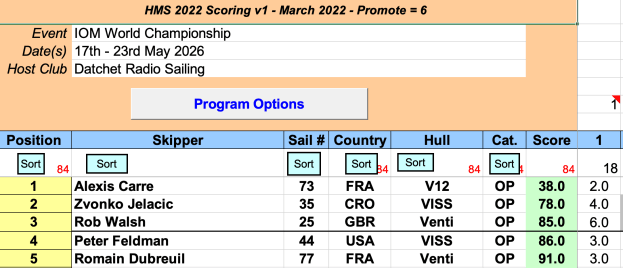
It’s not something that comes up in the normal run of things at a Club, but in HMS Excel, it’s quite easy to make such changes. In the Example above from the IOM Worlds, you will see that the Race Committee decided to show 3 character country codes where “Club/City” normally resides. They also decided to use the column which defaults to MYA Number to record Age Categories – Under 25, Open, Master, Grand Master etc.

How?

When you set up the spreadsheet ready to load the entry list, you can simply click on the pale blue coloured column headers and change/over-write the column title to anything you want …and click “save”.

IOM Worlds : Parallel Scoring 5 – Standard Redress Processing……!

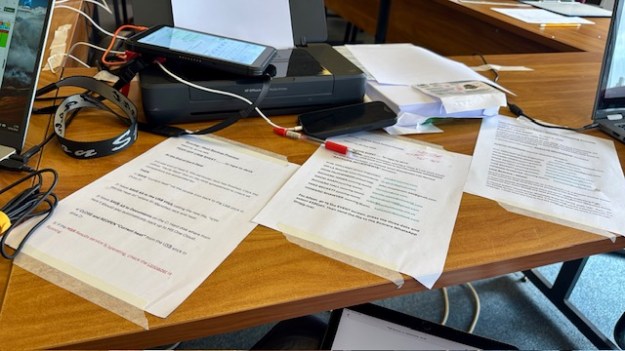
The photo above shows you our Scoring Team’s Process Crib Sheets. Note … taped to the desk (cleaners came every night), and angled in to the HMS Scorer position. We did a lot of preparation on “process” and we shall write about the importance of that in another article. There are three process sheets here:-

  • end of heat backups
  • end of race backups
  • end of race results publishing

There is of course one missing.

Standard Redress processing.

It’s missing because none of the Team, including me, understood in advance quite how important the work around Standard Redress was going to be. It’s massive.

It’s best tackled not at the end of the penultimate day… but in every race as you go through the Championship.

Most of us had never seen fully Umpired racing before. Interesting experience.

When the Umpires deliberate, a possible outcome is that an aggrieved party – knocked to the back of the fleet perhaps – can be awarded a “Standard Redress”. It is widely acknowledged by the Umpires that the HMS Excel scoring system does not have support for Standard Redress. This type of redress includes future score averages in races after the redress was awarded. It will be a manual calculation for the Scorers to complete after the last race of the penultimate day (look up on google or IOMWorlds2026 Jury Notice 1 for the Worlds). Redress awards given on the final day can use the standard HMS Excel button for “RDGave”. HMS Excel calculates redress awards looking backwards only – not into the future.

In UK, where use of HMS Excel is the norm, as there is no tool for Standard Redress we have a tendency not to use it. At the IOM Nationals we processed one. I’d not seen one before.

To be honest, it’s a very manual and error prone calculation. Get your calculator out and try one.

At the Worlds, after three days the Umpires had awarded three standard redresses. Concerned about what this would mean for workload at the end of the penultimate day:-

  • racing ends around 1830
  • scoring completes and winds down about 1900
  • 1-2 hours of standard redresses to calculate, check, check again and then apply to HMS Excel
  • drive home (1-2 hours)
  • eat main meal of the day
  • go to bed
  • get up at 5am and do it all over again

… so I emailed the Umpires to “alert them to Scorer’s concerns as to the viability” of averaging one Standard Redress per day.

In the next two days of racing the Umpires awarded another 7 Standard Redresses. So we had 11 in total, two of them with one competitor. I had brought my Casio calculator and a ruler just in case….

Essentially for 12% of the fleet, you pop them into a boutique scoring system of their own. We had to separately hand calculate special scores based on ALL heats to date, check the rounding to 0.05, remembering which scores to exclude. (a competitor with two awards is a trap!) Then you have to apply the WORSE/BETTER score test to each Redress … then decide whether to apply to or not …. then load the answers into HMS.

Then ….publish race results to competitors so they knew exactly where they stood going in for the final day.

If you’ve read this far, you’ll understand the Scorer’s alarm.

So what did we do??

In flight, we designed, built, tested and used our own Standard Redress tool in Excel on our fourth laptop. We kept it up to date as Umpire decisions arrived, and race by race. At this award rate, no alternative really.

https://drsailing.org/wp-content/uploads/2026/06/sailing-iom-worlds-standard-redress-tool-final-at-calculatin-at-1820hrs-22-may-2026-1.xlsx

You can download our Standard Redress tool here on this link.

You are welcome to use it. If you discover an error, honestly… don’t tell me.

Points to note:-

  • every skipper with an award is tracked through the entire regatta, race by race
  • when you get an award in race N, you have to dig out all the scores in Race(1-(N-1))
  • watch out for the result exclusions
  • a skipper can have more than one award (see CRO33) and you have to cope with that
  • rounding needs to be watched
  • BETTER/WORSE Test needs to be applied

There’s a lot of calculating in there and you will see for each competitor, we ran the BETTER/WORSE test manually.

Before you load these Redresses into HMS, you need to audit them carefully. There would be hell to pay if one of them was wrong – Race Team protested etc. So how to do that audit?? The Casio Calculator??

You will note in the spreadsheet that each awarded competitor was audited (checked) by AFleet. AFleet happily has a Standard Redress button and we used it to check the answers our new tool was producing. You will see them there coloured black. Only when everything agreed, did we release the calculations for processing. Did AFleet find an error in the spreadsheet?? Yes – one. It might otherwise have snuck through undetected. But we found it.

Thank heavens for Parallel Scoring, eh??

Funny side-story :

This was a feverish work session and the whole team was ultra-focussed on their own contribution. Intense, it was. We hammered through all the processing and safely got the correct double checked answers keyed back into HMS Excel. Then I said to the Afleet scorer, “OK that’s done. Let’s do the same on the AFleet results now.” My colleague looked at me blankly and replied, “No … I finished all that ages ago….”

It built a little tension into the Umpire-Scorer relationship, I can tell you. In a very kind gesture, the Umpires presented us with gin and fruit cake. They were OK guys after all !!!