Tag Archives: rm

Rig Tension – What Does That Mean in Radio Sailing?

When we all decide to come to radio sailing, one of the first things that grabs our onshore attention is people staring down masts with their knowing one-eyed look, tweaking stays with their sturdy race tuned fingers … and making clever approving noises. It’s great !
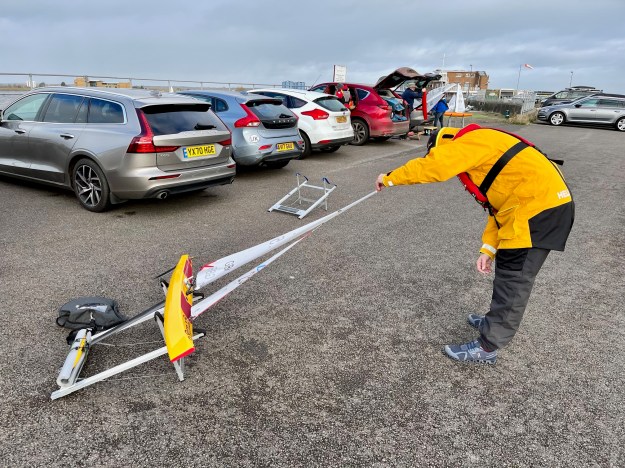
The curve of the mast is an interesting topic in itself. If you search Youtube for IOM videos you’ll hear experts looking for anything between “dead straight mast” to “a bit of prebend”.

Baffling, but fear not!!

On Nigel Barrow’s excellent website, he recommends a rig tension gauge by John Gill. It looks like this…

The sharp-eyed amongst you will notice John’s email address on the gauge if you want to contact him to get one. It’s a lovely carbon fibre thing – I just love it. Anyway, as Nigel points out, if you want to demystify your rig, get one of these.

If you are a keelboat sailor in your past, you’ll immediately recognise the basic idea. If you’ve had a Loos Gauge in your history, it is basically the same idea. I raced `Flying Fifteens for 25 years – the Loos Gauge is the central calibration measure for everything. I never went anywhere without mine. Honestly.

See those two big screws at the top of the gauge? You slide your shroud wire between those two (they stand proud) and the gauge gives you a way to understand rig tension versus deflection. Then you look up the gauge reading on a little chart, and if you know your wire diameter then you can read your tension in kgs.
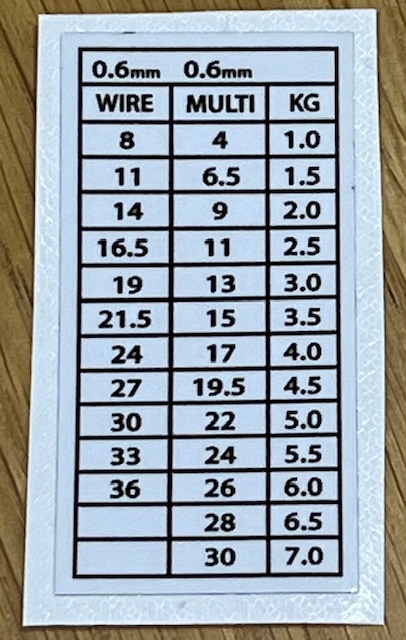
We used to do the same in Flying Fifteens, but I soon lost the appetite to know tension in kgs … all you need to know is what the damn gauge number is.

©John Gill

If you look at John Gill’s photos above, you’ll see the way to use the gauge. (a bit blurred, sorry)

As Nigel Barrow points out, it’s quite a revelation to know precisely if your IOM shrouds are carrying the same tension, or you pop a new replacement shroud in and you want to get the tension matched again. Very good.

In 2024 I set myself two other goals:-

  • I want to get a feeling of also what backstay tension readouts correspond with apparently good performance
  • Now what about Marbleheads? No shrouds…. But actually rig tension is a very black art in the Marblehead, and there must be a way to shine some light into my darkness. I want to write separately about measuring jib swivel tension on a Marblehead – but give me time.

Calibrate, calibrate, repeat, repeat…. my New Year Resolution for 2024

Wooden Stand with Carrying Handle – The Plans…

Following up on yesterday’s Item about what stand design to choose if you park a distance from where you sail :-

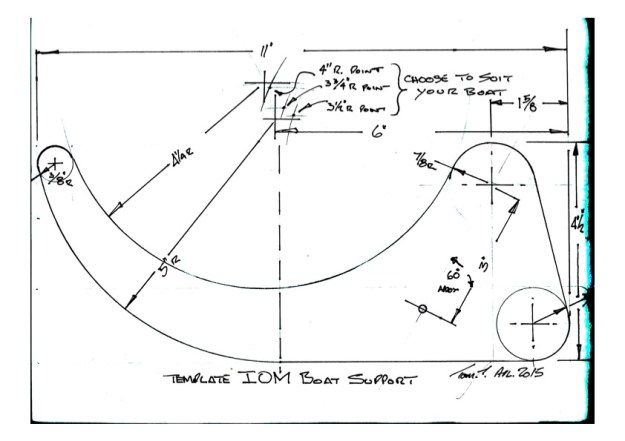
Kindly given to me by a friend at Chipstead, I’m going to attach here (for convenience) the plan drawings widely found on the internet for the wooden IOM stand with a carrying handle.

The drawings come in two pages:

  • the stand
  • The cradle part where your boat sits

These pictures can be devilish difficult to read on a small screen, so let me first offer you the pdf downloads

Our thanks to David Jensen for getting in touch about these brilliant designs that the sport now benefits from.

©David Jensen

Beginning to Radio Sail? Which Stand Design Do You Want? … Well, Where Do You Park the Car?

Sometimes, I think my brain is really slow….

I have a couple of aluminium type stands in the house, and I’m hoping for another one quite soon. You know, nice clean aluminium legs with straps for the boat hull to sit in. You see a lot of them around.

Then I was down at my Wednesday club and decided to help a pal who was moving from car to shore for the race session. It’s about a 200 yard walk. You have to carry your transmitter (round your neck), the boat, maybe your rig bag, and the stand… plus in his case a chair to sit upon during racing. It’s a major feat, let me tell you. My friend left me carry his easy chair.

Then it occurred to me that on that IOM race day, nobody was using an aluminium stand. All the competitors had wooden stands, some of them just fantastic pieces of beautiful joinery in their own right. Gorgeous.

It was only then that it occurred to me was was really going on. On all these stands there was (i) an integrated carrying handle – see the black bar in the photo above (ii) the boat could be strapped securely to the stand. ….. When walking from the car park to the shore, you need one less arm. You simply pick up the stand by the handle and the boat gets a safe free ride.

There were interesting variations in keel supports (see above) ranging from velcro straps or bungee cords, or in one case a U-shaped keel support which would have its merits.

We have published links elsewhere on this website (see the Category list and select “Stands”) with plans for wooden IOM stands like this.

When the weather warms up, I might have a go.

So the answer to “What type of Stand do I need?’, might just be, “Where Do You Park?”