Our third radio sailing transmitter guide has just gone online – this time for Spektrum !
All our latest transmitter features are in there. Take a look if you can ! Errors, omissions and amendments gratefully accepted. Just email them in via our Contact page.
To read it, click on RADIOS in the Menu Bar above.
Fellow members GH and RU are always ribbing me in the bar that I should just chuck my Futaba antenna wires into the pot as a frame makes no difference!! G and R – this test result is for you!
For some time, I have used a 3D printed Antenna Frame from SailsEtc for £5.50. Do you all know what I am talking about??
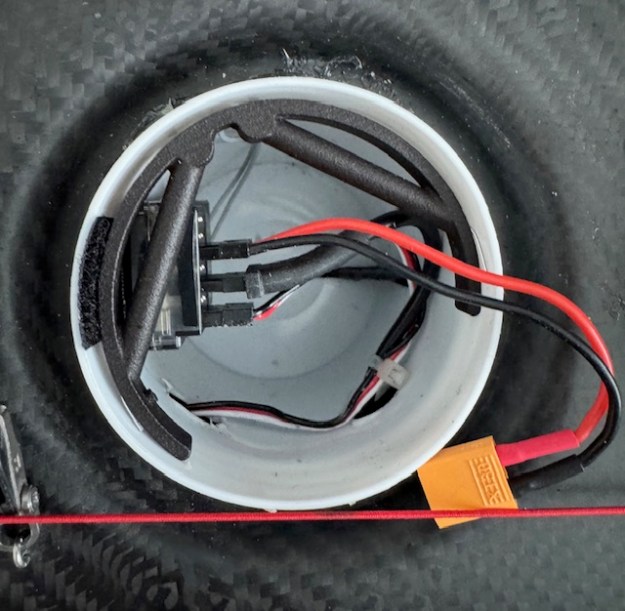
Here is my frame installed in a beautiful UK built F6 Marblehead. It is that little black arc you can see at the top of the pot. You might think that dangly wires on the receiver are “all aerial”…. but the lengths of aerial wire shrouded in grey that you can see in the photo are actually shielded. The lengths of wire that are unshielded and the actual “signal” bits, are the 5-6 cm end tips that are threaded into the frame at right angles. If you have Futaba receivers these tails have total length of around 8-10cm. If you have an RM ER6 the tails are 20cm long – but it’s still only the 5cm tips that pick up signal.
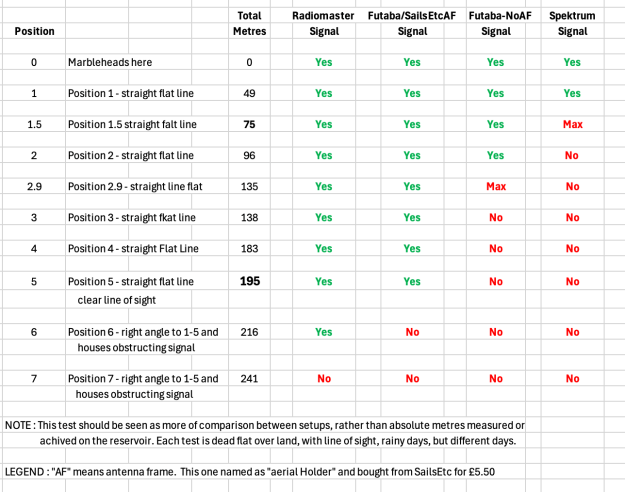
First of all, I’d stress that although the measurements above are done in metres, it’s not an accurate measurement of ON THE RACE COURSE range. It’s better thought of as a comparative measure between technologies. At the Club there are definitely less signal obstructions around plus VERY importantly the control area is raised above the water by around 3-4 metres. Signal there should go further.
Instead think of this comparison as a %age comparison benchmark. If Radiomnaster ELRS is 100%, Futaba with antenna frame is around 98%, Futaba without antenna frame is about 67%, Spektrum is around 37%. All these signal ranges are perfectly good enough to go radio sailing. Honestly, the 200 metre benchmark would be impossible to race in, so you might say…”who cares?”.
So how did we get on?? Any conclusions??
1/ Adding the Antenna Frame increased my Futaba radio reception range by 50% on the test “course”
2/ Adding the frame put the Futaba in just about the same league as Radiomaster ELRS setup using a ceramic aerial. … further than you can reasonably see a radio controlled boat for racing purposes. I’d guess that a RM ER6 receiver would change the range-game again and be in another league altogether. NB uses one in his VISS.
3/ Most probably all these receiver components come from the same Chinese factory, so I’m still thinking that a FlySky setup would benefit by 50% with an antenna frame.
4/ If you have a Futaba in a SailboatRC boat, check the threading of the tails. Thankfully no carbon fibre to worry about, and the custom pot is fabulous with ready threading holes for the antenna. However, check where the tips are. If it ever stops raining, I’ll try the test with my K2/Futaba T6K.
These ranges are not as far as flyers claim for planes, but all ranges are much more than we need for sailing.
GH : bring you FlySky over in a carbon hull and we’ll check the range… with and without an antenna frame!!
How far away can we see race marks, start line situations and sail numbers? Not far.
I’ve just had a bit of a shock though. You may remember that I have a horizontal, dead straight, line-of-sight, transmitter range test based in the street where I live.
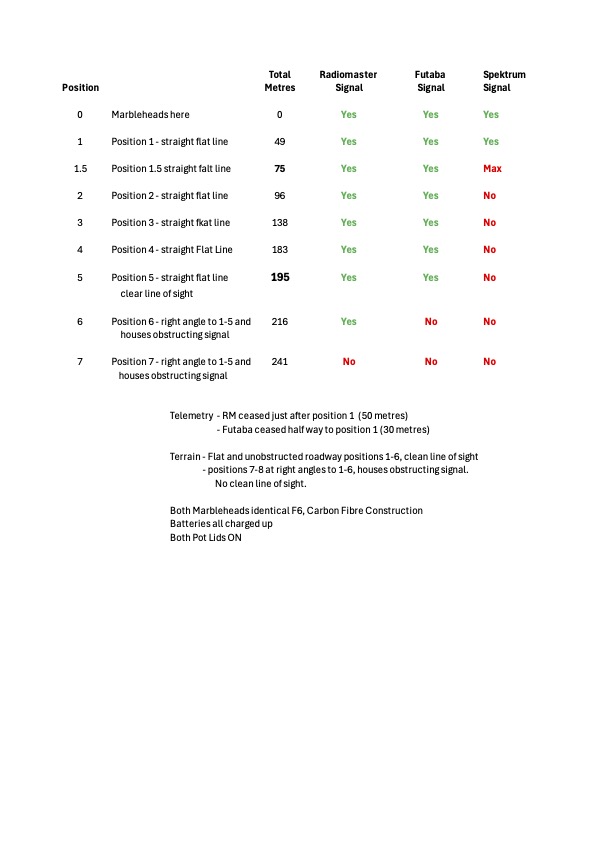
I recently put Radiomaster and Futaba through the exact same test and basically got a radio range of around 200 metres for both of them. Blimey.
Radiomaster just a tad more maybe, but I ran out of straight street and had to go round the corner. That is way more than we need in radio sailing.. I can hardly walk THAT far.
You can read my recent range comparison for Radiomaster and Futaba here:-
Tests conducted by RC Flyers in the USA suggested that Spektrum only reached maybe a quarter to half the distance of Radiomaster/ELRS. I was curious to test my DX8e against it. I am just starting to prepare the Datchet Radio Sailors’ online manual for Spektrum. I thought I’d put my own lovely Spektrum DX8/AR620 through the same range test, using the same boat…. before I start the programming and manual writing.
I’m a bit stunned. At first, I thought it must be low battery power, and so changed all the batteries for fresh ones. Same result. So my next thought,… after swearing,… was “faulty transmitter”…. (you might say!!) …. but I’ve had this particular DX8 range tested and a fix applied at the Spektrum UK distributor, and it passed their tests just fine after that.
You might be thinking that it was caused by the smart but tiny, and wire free, ceramic antenna of the AR620 receiver. Maybe. Lovely kit though.
But the Radiomaster in this test also used a ceramic antenna in its ERC3i – even more weeny and more tiny that is. It’s so small, you’d be inclined to try and wipe it off the hull in case it’s a speck of mud.
The AR620 is about twice the physical size of the ER3Ci. When I get the time, I’ll re-test the Futabas without the SailsEtc antenna frame … just dangling wires in the pot … to be disproved, but I personally suspect the antenna frame (called “aerial holder” at SailsEtc’s website) is a big factor in this test.
I’m reluctant to trot down to TJD Models and buy a wire-antenna Spektrum receiver, as I’ve seen an official Spektrum video claiming that the ceramic antenna has better range.
But – well, how much do we need in radio sailing? I’d personally have difficulty racing 75 metres away – it’s surprising how far that is. I know a number of radio sailors who simply adore their Spektrums… but for myself, I’m still surprised by this test result. The guys at Datchet want me to test a FlySky over the same street. I’ll do that as soon as it’s practical – I no longer have a FlySky here, but I know where to get a loaner.
The article showing the results of the USA flyers can be found here:-

 Datchet Radio Sailing - Making It All Much Easier !!