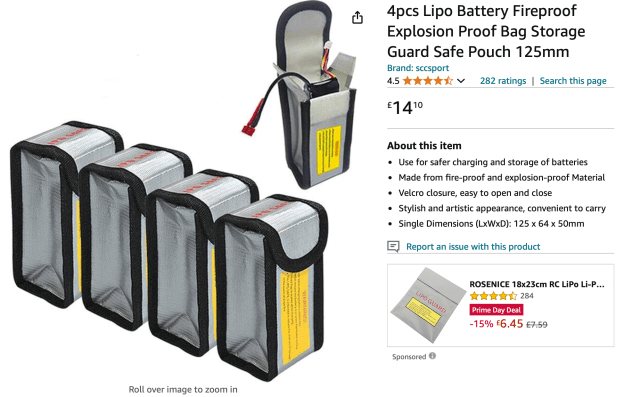
Nigel B recently showed me a very neat little battery bag you get from amazon.
Actually you buy them in bags of four at an embarrassingly low price. You can get two or three 2-cell LIPOs or LIFEs in there easily.
I’ve been wanting to neaten up and smarten up my battery storage recently. These things are ideal, because of the outer bag that I use.
It keeps all the batteries in neat little pockets so that during race day it is much easier to remember where you are with power supplies. I reckon I could get another four little bags and then easily store 8 of them inside my outer bag. Very neat and tidy.
All inside this single outer bag. You could easily store 20-24 batteries in there very neatly, bagged boy connector type maybe.
Thank you, Nigel!! This was the Amazon page…. £14 for four.
Around Christmas time, SM suggested that I write some entries here about batteries and electric power. It’s a little daunting, as I suspect SM knows more about this than I do… but here goes…
Mostly I want to write about four things
Batteries, identifiers….LIPO v LIFE, safety and all that
In-boat connectors
Battery Damage causes
Charging
It won’t be long after you start radio sailing that somebody starts chatting to you about batteries and especially about the LIPO v LIFE debate. There’s loads of other topics in the same area that divide opinion too.
Let’s start about the batteries though. There will be other materials available inside the batteries, but in the main, in radio sailing we need rechargeables, and either LIPO or LIFE type. As far as I can see, they need their own charging regimes but more of that later.
Before any of us went radio sailing, we would look for two things on the outside of a battery that normal humans buy in Tesco
– the physical size represented by a code like AA or AAA or C2032
– the voltage
The is hilariously misleading for radio sailing because firstly the physical size and shape doesn’t seem to have a code at all , as far as I can see. They vary a lot. They sometimes but not always tell you how many cells are in there. Second, all mine have the voltage on like 6.6v or 7.4v… but when you charge them up they always accept more than this voltage. Baffling, but I set it aside. It’s a guideline.
The other number which could be interesting, that is how much sustained current you can pull out of them measured in amps. Like some kind of measure of how fast you can pump petrol out of a car’s tank – something like that. I think the principle is that LIPO can deliver higher amps than LIFE can. This number is not written on the outside of any of my batteries, but we shall return to its importance in a later news post.
I thought with electric cars the best advice is keep the engine charged between 10% and 80%. By the way, at east two of my little instruction sheets for my sailing batteries say to recharge them at 50% of the nominal voltage. I’m trying to stick by that.
The battery material type should be written on the outside, else how would you know what charging regime you need. At least two of my batteries do not say what’s inside, though I know they are LIPO. I might have to put my own labels on!
Have you ever looked on google or YouTube using the search term “battery fire”? Not to pick on Tesla cars, but quite a few of those come up. I feel they are being picked on unfairly! Well, anyway, that basically is what the radio sailing chatter can be about too – LIPOs have a reputation for fire damage. When I acquired three LIPO batteries for the IOM they came in a fire proof bag…. for heaven’s sake. Allegedly, LIFE batteries are safer in that regard.
I thought it was all over played, then the very first expert I asked about it at the Club said, “oh yes – I’ve had some catch fire”. I was stunned. So, to form a better opinion I decided to buy both types and see how they perform. I keep mine in a fire proof bag and I keep that inside an explosion-proof bag. Honestly. More on that later, but the bags are cheap enough and I want to stay married.
Of the numbers stamped on the batteries (my battery collection has two to four numbers stamped on the outside), the ones to look at are (i) voltage – searching for analogies, but think of it as a bit like octane in petrol. It is some kind of expression of power – but firstly all mine charge a tad higher than labelled, and the voltage available anyway changes constantly during your sailing day. (ii) the next number you want is m.a.h. – milliamp hours. It is kind of a measure of how much petrol you have in the car tank. Sail gently and the battery lasts longer, adjust the controls more and you battery lasts less time on the water. It’s how much total energy you allegedly have on board.
For 2023, I moved my IOM from house to club by padding the car boot floor with old towels – then laying the boat on its port side, nose to the front along the left hand side of the boot. Got the picture?? One day, under sharp braking I almost got an IOM in the left ear… so I learned put a tool box in front of the leading edge of the fin, basically locking the boat in position. It works OK, but we shall all just pack our car boots in whatever way suits us!!
By the way, if you use the method above…. don’t pack the boat in rudder to the front – the rudder would be very exposed to damage with a dab on the brakes.
I became quite interested in the idea of removing the fin and bulb for travel, when I saw a rather super bag system from, I think…. Catsails. They declined to make me another though, and I don’t think it is currently listed on their website. You need their fin bag as well !! Looks great though!
Then two things happened –
Recounting the “IOM in the ear story” to the friend who had loaned me an IOM, he recommended a Potter “Onesie” that protects the whole boat and fin, with great carrying handles and everything. You do need to develop the knack of sliding the boat in and out of the bag safely, but actually it does inspire confidence in the car boot.
I was still slightly hankering to try a “keel off” type padded bag arrangement that I had seen from Catsails. However, when my new IOM arrived from SailboatRC they specifically said “don’t keep taking the fin on and off for each weekend!!”
They want the fins left ON…. Upon reflection I guess it makes sense and I’m going to be a Onesie-Fan.
By the way, Nigel Barrow has made his boat a protective hull box which is rather fetching. Maybe that’s my 2025 project.
I might say that with the Marbleheads, I think we all take the fin off each and every weekend !! I’ll do an article soon on the rather luxurious, German made, hull bag that we have for that. It’s a nice idea too.




 Datchet Radio Sailing - Making It All Much Easier !!