Tag Archives: radiomaster

Transmitter Type and Snug-Cover, Best Fit…..!!

We had something of an “ah ha” moment here the other day when the Domestic Steering Committee (a seamstress of note), reminded me that transmitters and snugs are a 3-dimensional design challenge not easily thought of or seen in 2D…

We went back to the snug and transmitter inventory and tried all combinations of transmitters and snugs to see if basically it really is “choose anything you want”. If you’re a Flysky or Futaba user, you might get an “ah ha” moment too.

First up, when I use my Radiomaster Pocket I realise now I’ve always tended to use it without a cover. The transmitter is so ridiculously robust I suppose it felt best to use it in the open air. It was anyway so small it is lost inside a snug.

The second really important thing is that my fabulous Catsails snug is a terrific cover and will basically take anything you want to pop in there with ease – with a Spektrum it can easily accommodate the stubby aerial at any angle you prefer.

It’ll be interesting to see what SailboatRC come up with in their forthcoming snug design.

What’s the Thing About a 3D Snug Design?

It’s in the implementation….

The Steering Committee’s head seamstress pointed out there are differing approaches here to creating a 3D space for the transmitter. Catsails are basically using what a dressmaker thinks of as “darts”… apparently… there’s a single seam with different material sizes each side of the seam causing a ‘compartment’ effect.

The Rooster…

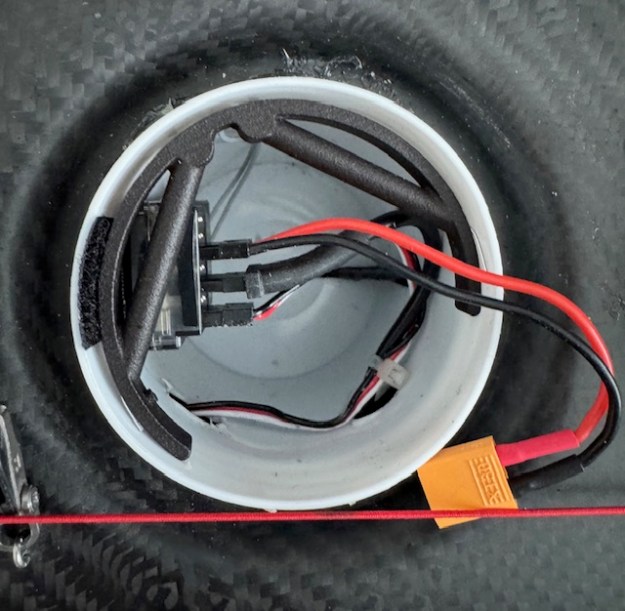
That brings us to the Rooster…. with a different approach to creating a 3D shape based upon multiple seams. They are creating the 3D space more by design with seams along the edges of the 3D space. (see photo at the top of this article)

Can you see there are four seams on the Rooster?? Taped flat on the outside (the Catsails outside seam is “piped”) and also miraculously also flat on the inside for comfort maybe…

In sewing, this is apparently called “flat felling” or “flat locking”. Just so you know…

Given the two people that will have had a big hand (sic) in designing the Rooster snug, it suddenly comes as no surprise to me now that the Rooster 3D space is a really great fit on Flysky and Futaba, like it was designed for them. Like a glove….. My lovely Spektrum is a better fit in the Catsails snug. The antenna stem is something of a compromise inside the Rooster. Enjoy choosing!

ELRS … So The Commodore Was Correct ….!!

Our Commodore, Phil H, has long been very keen on the performance of his Radiomaster-ELRS receiver… “never dropped a signal”, he says.

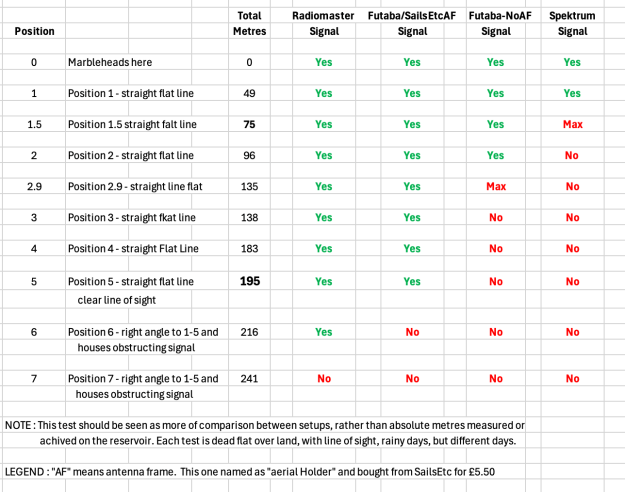
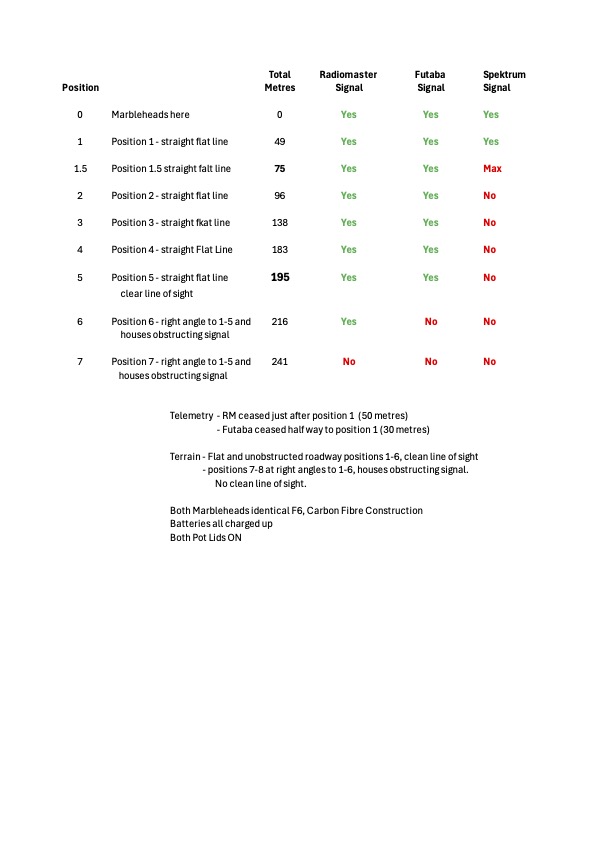
Can you read that table above ? – it’s a tad blurry, but I think you can. These are ground-to- ground test results of some major transmitter-receiver brands aimed at the Radio Flying community, …who are interested in distances measured in kilometres..

The test might also typically be using receivers with a lot more channels than we use in sailing. The test person gets more into the transmitters, but receiver capability will be a big part of the equation.

You have to keep a sense of proportion – flyers seem to worry about ranges measured in kilometres, whereas, honestly, if our boats are 100m away I panic about whether I’ll hit a mark…. or not be able to tell which one of the pack is “me” !!

No need for us to be extremely picky about range and distance, but it’s all relative….

Sure enough, Phil – the major conclusion of the test is that ELRS is basically in a class of its own. FrSky Tandem was quite close (see our recent website article), but we don’t see many of those. You can see why the tests were controversial, but essentially they left the receivers in one spot then drove the transmitters into the distance (flattish undulating terrain) until they dropped signal. I think at one point they drive over a hill and see if the signal is regained the other side.

When you are dealing with radio sailing distances of 100 metres or so, if you have signal drops you probably need to check out other parts of the system. … Interesting though…. The full link of this 2024 video is given below – it’s long and much of it somewhat heavy going. If you skip forward to around the 1’17”, the summary and results start around there.

https://www.youtube.com/watch?v=LargnWPSX04

FR Sky Transmitters…!!

I managed to get my hands on one of these a couple of days ago. From the airplane and gliding world, the FrSky Tandem X20….. Bit of a wow. It was interesting to see what they use over in flying.

They cost about double (450GBPs) what radio sailors would think of as “pricey”, but can you tell the difference?

Amazingly – a resounding “yes”…. the feel was a huge step up from what we are used to. The body was a lot more solid (alloy maybe) and interestingly weighed about 900g so a bit heavier than common radio sailing transmitters. It felt very good in my size/shape hands. The “Apple” of transmitters maybe.

Gimballs (“Hall gimbals”) very smooth and more central on the console which somehow gave a nice balance (nearer centre of gravity perhaps) while you used it. Thinking about it more, if you move the screen to the top of the unit (most of our transmitters have the screen at the bottom), you can then move the gimbals down lower on the console itself.

Another thing I noticed was that the gimbals can be rotated slightly for those in search of more comfort over longer periods. Somehow, the whole thing looked more showerproof too. Really tightly fitted together.

When we decided to write the radio sailing manual for Radiomaster transmitters, I came across FrSky because the previous range FrSky along with Radiomaster use the same OpenTX software. FrSky seem to have abandoned that OpenTX strategy now as it was holding them back. They have done their own modern looking operating software called EthOS. That’s amazing too – it’s like having a full iPhone aboard, …all icons, colour and sexiness. Lots of preloaded configurations for power mixing and the like.

I might have misunderstood, but the owner said you could send updates (like custom model configurations) to it “over the air”…. so he can swap configurations with friends very easily.

The owner of the unit that I tried was a Competition Gliding fan. I asked what he used previously, and interestingly he had a Spektrum DX6E – which of course is very common in sailing.

Way over-configured for the needs of radiosailing, but it was interesting to see what £450 would buy you.