

Hopefully your new boat comes with batteries and is all set ready to go. Your battery is in top condition?!
What if it isn’t?? What if you anyway decide to treat your new boat to some new batteries!!??
Well, a big barrier to get over right away is the answer to “What Connector?” . When you go battery buying you’ll hopefully see that you can select the type of connector you want (£), or if you are unlucky enough to find they only list a connector that you don’t want, then call them. For a few pounds, you’ll eventually get the battery-connector configuration that you want.
Can you look at the photo above…. that’s the One Metre I borrowed to get started. I adored that boat.
Can you see that tiny flat little red connector? I think it is called a JST (“Japan Solderless Terminal”). The part you see is the female half, so the red male part is really tiny. I have a feeling that it can carry a current of 5 amps maximum, but I may be misremembering and it’s less than that.
The in-thing in the world of radio sailing connectors seems to be XT connectors. I’ve only been sailing a short while and I already find I have two connector types. My Marblehead has XT30 and my One Metre has XT60. So what is going on?

The XT60 connector on my One Metre.
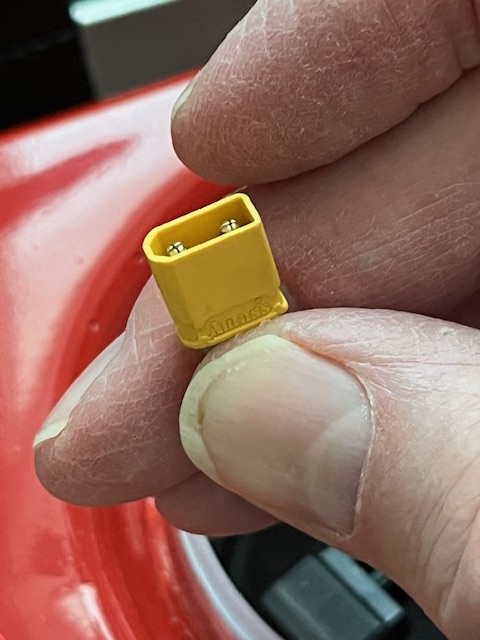
The XT30 connector on the Marblehead.
The ratings for these connectors is 60 amps maximum on XT60 and 30amps on XT30. The other real world difference is that the XT60 is a jolly sight easier to plug and unplug – big fingers, small plugs….
What’s going on ?
Honestly in that ten year old boat I borrowed I never once thought I couldn’t sheet in fast enough. So what’s happening? Well, bigger is better and batteries can indeed pump out more amps at a time than they did ten years back. Batteries are improving very quickly. still – if you stick 30amps up your finger you’ll get one hell of a tickle, not to mention 60amps.
Did you read Paul Elvstrom’s “Expert Dinghy Racing” when you were growing up. There’s a story in there about winning a race by throwing in rapid gybes in succession on the run to accelerate the boat. The eagle eyed amongst you following the 2023 IOM European Championship will have read that the winner was doing the same thing as Elvstrom. To do this he had a bigger drum on his sheet winch, so that he could throw the boom across quickly. To drive the bigger drum… you need more current. You may indeed need LIPO capability aboard but your connectors need to handle it safely. So this may be a strategic direction of travel !!
Anyway, each of my two boats has XT connectors of different sizes.
- so my batteries need to be dedicated to each boat….
- when I buy my batteries I need to be careful to buy the correct connector ends. I’m told they are very challenging to solder yourself (see YouTube). Things change all the time, but when I bought Overland LIPO batteries the connector was a simple drop-down option on their website. When I ordered LIFE from Vapex, I had two ring them up to get the connectors I needed put on before purchase.
Why might we not have XT60 ready on the Marblehead – weight weighty weight !!
There are also implications for how you charge batteries with differing connectors. More about that in the next post!!
So think ahead! Good luck getting into this one!!


 Datchet Radio Sailing - Making It All Much Easier !!