
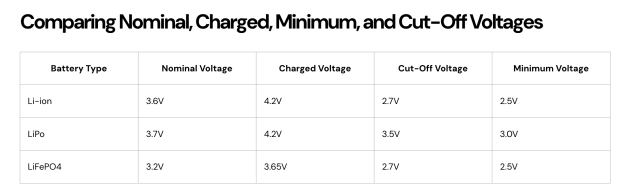
Even beginners to our sport encounter this debate pretty quickly. LiPos versus LiFes…
I was a little alarmed and disturbed to find my lovely 1800mah LiPos had all suddenly become puffy at the same time. Just two years old…The plastic covering on each battery seemed to be puffed with air/gas not fluid.
Pity – but I’ve realised now I’ve always been anxious about them in the house. They had an easy life – 18C-20C controlled temperature storage, not all that many charges, and always kept in double explosion bags. They have only ever been charged on a LiPo specific intelligent charger at 1amp max, and it cuts off when they’re full.
Mostly I’ve been confident about having them in the house, until hilarious friends email me YouTubes of Teslas catching fire……
So how to best dispose of puffy or leaky Lipos??
I thought perhaps puffiness with just air in there, no fluid,… was possibly OK… but see below. However, everyone agrees that LiPos can’t go in the household waste, not at the supermarket battery collection points either (not for Lithiums). If Waitrose caught fire, I’d never hear the end of it. They need to go to the official battery disposal place at the town dump.
You can’t just take them to the dump though. Best advice I could find was;-
1/ Deplete them totally.
I found they would go to zero current if attached to a receiver for 12-15 hours each. Alarmingly, instead of reducing the gas inside there, they actually expanded further. Blimey. I thought they were going to go “pop”… Like little balloons.
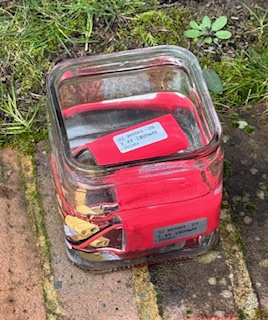
2/ Immerse them in salt water OUTSIDE for 48 hours.(see photo)
I found the most distant corner of the garden.
This is meant to neutralise the connectors and chemicals. Well, HUGE surprise – the water around these apparently “probably still OK” batteries turned a pile milky blue – lots of sediment in the bottom of the jar. So there really was something leaky in there… I threw that down a street drain.
3/ Now they are safe to go to the dump…..
UPDATE : Waitrose do indeed take Lithiums (see their website) – they just ask you to tape over the terminals before you pop them in the collection point.
I’m going to replace them with Hacker 1300mah LiFe’s, same weight to within a gram, same XT60 connectors. More on that later when they go through trials. I have maybe another 6 LiPos in the explosion bag from different manufacturers. I shall be really watching and inspecting them closely.
 Datchet Radio Sailing - Making It All Much Easier !!