
Do you get anxious with carrying your delicate transmitter around in the boot of the car… kind of sliding and rolling around?? It has been worrying me. Delicate joysticks and all that.
My Radiomaster Pocket feels like you could throw it across the room and it would come up smiling. Blinking tough, they are. The rest of my transmitters, less so.
Do you have Futaba? Half of our club do. Very popular 🙂 I’ve been looking online for bags or cases for the transmitters simply to protect them from bashes. I found some cheap ones made of black felt which didn’t inspire. I also found some smart steel cases (very sexy in a way) with foam inserts (allegedly for Futaba) but they only take one transmitter at a time and are unreasonably expensive I felt. If you are a two transmitter person, that means lugging two suitcase things into the car each weekend and that’s just before you load the boats and rigs. I felt… not good.
Then by complete accident, I discovered this from Black and Decker. Their standard 19inch toolbox – available everywhere globally I’d guess for about £20 if you’re lucky. I bought mine in UK Homebase DIY Store – in the start of year sales.

Before I show you the inside, those two little red flap compartments on top are good for spare receivers, batteries etc. Very quick access….
But Futaba lovers – look at this!!

It’s like the toolbox was made for our transmitters. Amazing ! One transmitter, no problem! You could get one or even two in there – and the size even protects your transmitter switches just perfectly. Can you see in the photo that the switches are held securely in free space?
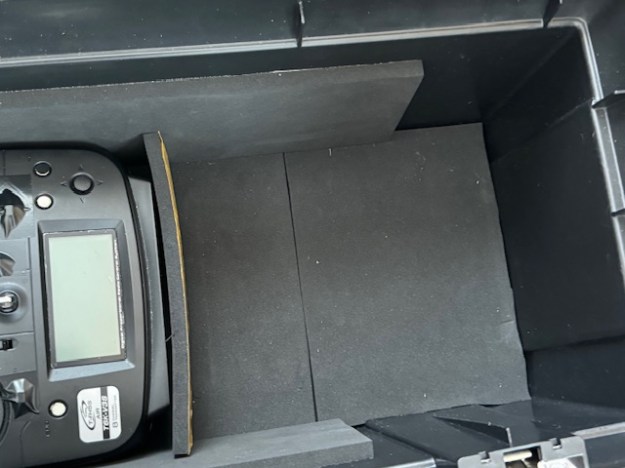
To stop them bouncing around, I simply popped some sticky back neoprene in there. The end corners are deliberately not lined as that’s where the switches will sit. It’s really snug and the neoprene holds them like a gloved female hand. You can see I have one piece of loose neoprene to separate two radios.
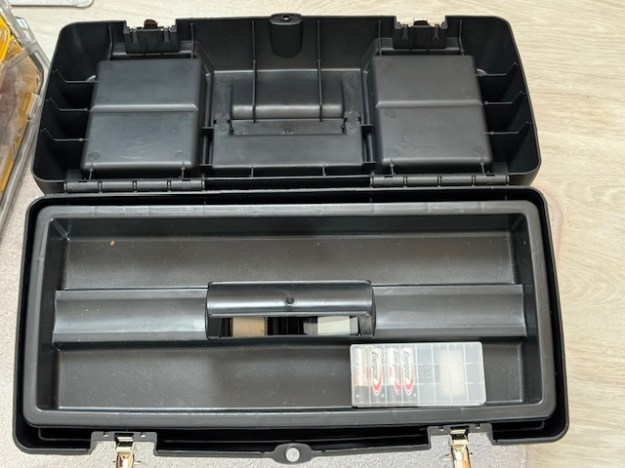
On top fits a loose tray – great for batteries, voltage testers, or whatever you want.
I tipped the tray over and did this…

I put four neoprene pads to sit over where the joysticks are situated. I reckon that if the transmitter wriggles out (unlikely) of the gloved female grip, they can only move upward 10mm before they touch this neoprene. I might put an extra layer of neoprene in the bottom of the box to lift them up and close that gap completely.
What do you think?? Good for £20 ??
I even like it that it looks anonymous and doesn’t shout “please steal me”!!!
By the way, I have tried it on my Spektrum and it’s too wide for this. So Futaba people, this idea is just for you !!


 Datchet Radio Sailing - Making It All Much Easier !!