Tag Archives: tools

Beginner’s Guide : The Fin-Bolt Nut (Tools!)

Do you take your fin off every weekend??

SailboatRC recommend leaving the IOM fin on, so I religiously do so – and have one of those lovely Potter Onesie padded bags for the whole thing. The fin is attached with an M3 bolt, needing a 2.5mm hex key.

In the Marbleheads, the fins are that bit longer – we all take the fin on and off every weekend as “the norm”. I had an M3 bolt on there, which turned out to be not really up to the job – too much leaping across the Datchet waves! Doctor Hetem has popped in an M4 bolt for me now (needs 3mm hex key) and I’m much more confident in it. I wouldn’t want my fin to be the third in living memory to have dropped to the bottom of the lake!

GH was careful to tell me to be very wary of over-tightening the bolt. I’ve been using simple hex keys left over from my cycling club days – nice ones with those round “any angle” ends on them. On the wide side, there’s about a 75mm throw so maybe the available leverage is a bit high. (See photo above). Too easy to over-tighten.
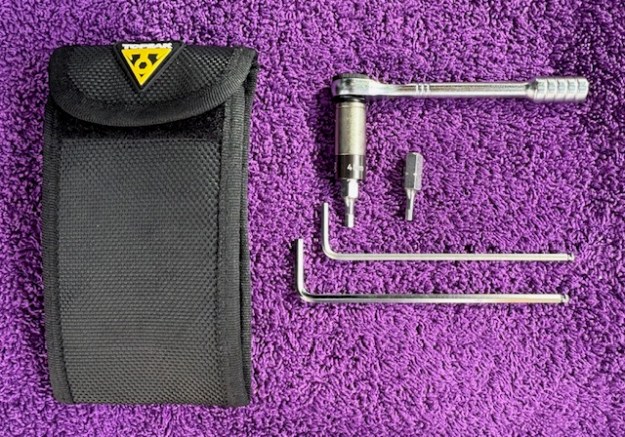
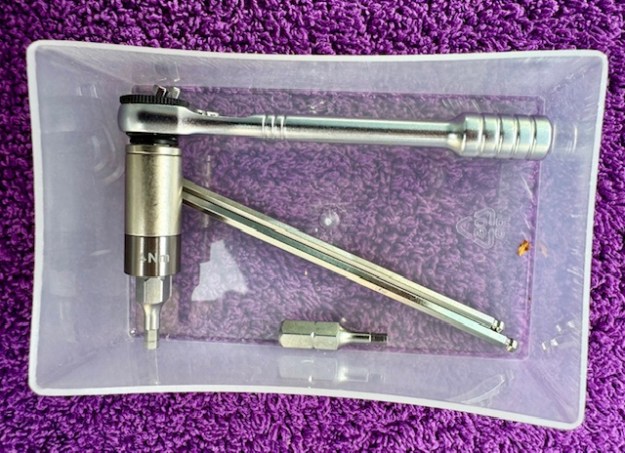
GH recommended one of those T-bar hex keys. However, as I dipped into the old race bike tool box I suddenly remembered I had a mini ratchet/torque wrench from a brand called Topeak (very big brand in global cycling). It has 2.5 and 3.0mm keys in the selection. The torque heads can do 4,5,6nm of measured torque, but I feel that even 4nm is a tad much for the Marblehead fin. However, as you throw the lever you can easily feel the “bite point”. Simply to provide shaft length to clear the deck well around the mast, I have the 4nm head on there in the photo (above), but have never let it “click”. If you look carefully at the top photo you can see “4nm” engraved on the shaft extension.
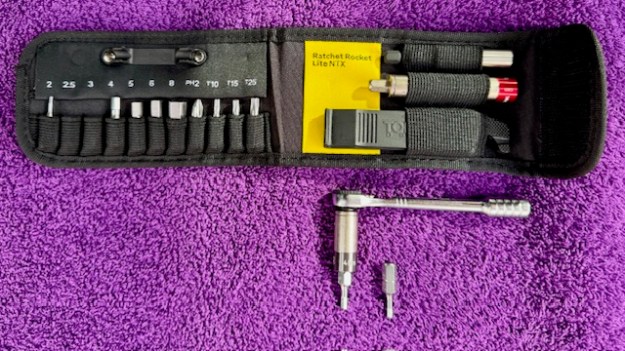
The ratchet on the handle is a dream for putting our long fin bolts in and out. Love it. Plenty of space in the tool box too. It comes with a little pouch, but my preference has come to be keeping the subset I need in a neat translucent plastic box – which turns out to be an old business. card box. I knew I’d find a use for those one day 🙂

The whole thing will be great for the Ten Rater (of my dreams) too !
You can see the current product on the Topeak website at this link below. Even better, the current product has 1-6nm of torque adjustment, an improvement over the 4/5/6nm set that I have. Click here:-

https://www.topeak.com/global/en/product/1602-TORQ-ROCKET-mini-DX
Rig Tension – What Does That Mean in Radio Sailing?

When we all decide to come to radio sailing, one of the first things that grabs our onshore attention is people staring down masts with their knowing one-eyed look, tweaking stays with their sturdy race tuned fingers … and making clever approving noises. It’s great !

The curve of the mast is an interesting topic in itself. If you search Youtube for IOM videos you’ll hear experts looking for anything between “dead straight mast” to “a bit of prebend”.

Baffling, but fear not!!

On Nigel Barrow’s excellent website, he recommends a rig tension gauge by John Gill. It looks like this…

The sharp-eyed amongst you will notice John’s email address on the gauge if you want to contact him to get one. It’s a lovely carbon fibre thing – I just love it. Anyway, as Nigel points out, if you want to demystify your rig, get one of these.

If you are a keelboat sailor in your past, you’ll immediately recognise the basic idea. If you’ve had a Loos Gauge in your history, it is basically the same idea. I raced `Flying Fifteens for 25 years – the Loos Gauge is the central calibration measure for everything. I never went anywhere without mine. Honestly.

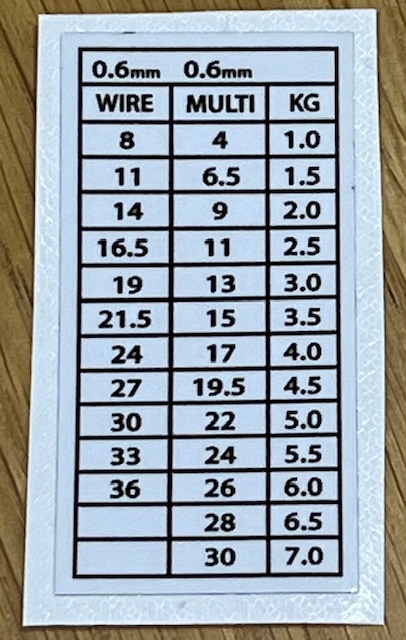
See those two big screws at the top of the gauge? You slide your shroud wire between those two (they stand proud) and the gauge gives you a way to understand rig tension versus deflection. Then you look up the gauge reading on a little chart, and if you know your wire diameter then you can read your tension in kgs.

We used to do the same in Flying Fifteens, but I soon lost the appetite to know tension in kgs … all you need to know is what the damn gauge number is.

©John Gill

If you look at John Gill’s photos above, you’ll see the way to use the gauge. (a bit blurred, sorry)

As Nigel Barrow points out, it’s quite a revelation to know precisely if your IOM shrouds are carrying the same tension, or you pop a new replacement shroud in and you want to get the tension matched again. Very good.

In 2024 I set myself two other goals:-

  • I want to get a feeling of also what backstay tension readouts correspond with apparently good performance
  • Now what about Marbleheads? No shrouds…. But actually rig tension is a very black art in the Marblehead, and there must be a way to shine some light into my darkness. I want to write separately about measuring jib swivel tension on a Marblehead – but give me time.

Calibrate, calibrate, repeat, repeat…. my New Year Resolution for 2024

What’s In Your Toolbox? Allen-keys and Screwdrivers and….

When I came to radio sailing, an early realisation was that my lifetime sailing tools and their toolboxes were going to be useless. An interesting challenge with radio sailing is, relative to big boats, the smallness of everything.

You need some basic tools on hand, just right at the start – to give you confidence apart from anything else.

These are the first four things I dropped in my new radio sailing toolbox.

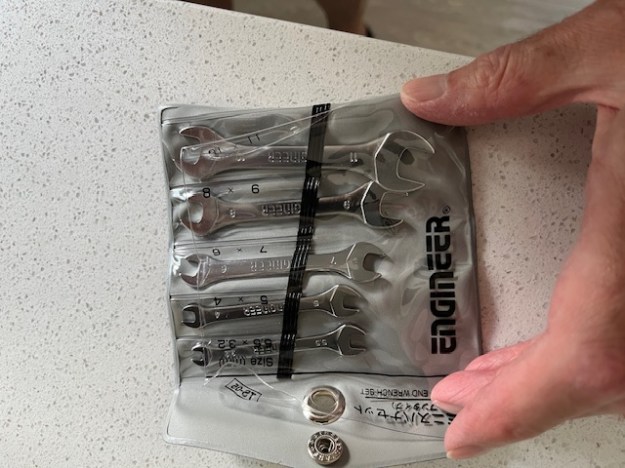
1/ If you see any hex nuts, they are going to be small. For example, shroud rigging screws on an IOM. I bought these:-

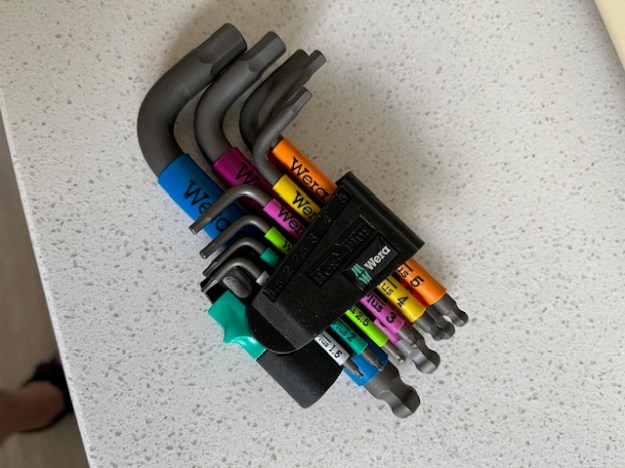
2/ So far, I’d say slightly more in demand, some good allen keys. I have found so far that 2.5 size is in high demand. From my cycling days I had a lovely set of allen keys, going right down to 2mm and having the magic 2.5mm. However, the keys have quite long stems … possibly 10cm. I think you also need something shorter, and you anyway should be carrying two sets to protect yourself against losses. I what I went for with the second set was these (below). It’s got the magic 2.5mm, plus they have short stems for tight spaces but I really, really like the colour coding.

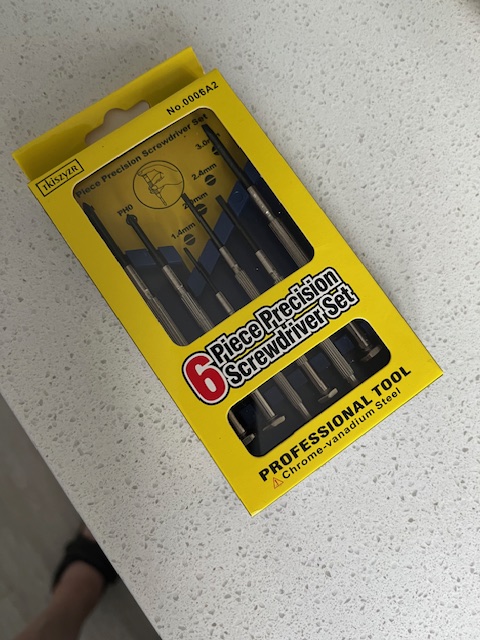
3/ I’ve not had to break open the screwdrivers yet, but where there are screws they are jolly small. For the moment I have packed a set of these

4/ Again different to big boat sailing, I felt I needed some glue in the box. If I have superglue in the box for rigging knots, then I thought I might need something a bit milder – non impact adhesive to allow wiggle room. I bought this silicone glue. I see it has already been used!

So that was my four part toolbox for day one of radio sailing. Oh – I bought some long tweezers too. More about those in another post.