SailboatRC recommend leaving the IOM fin on, so I religiously do so – and have one of those lovely Potter Onesie padded bags for the whole thing. The fin is attached with an M3 bolt, needing a 2.5mm hex key.
In the Marbleheads, the fins are that bit longer – we all take the fin on and off every weekend as “the norm”. I had an M3 bolt on there, which turned out to be not really up to the job – too much leaping across the Datchet waves! Doctor Hetem has popped in an M4 bolt for me now (needs 3mm hex key) and I’m much more confident in it. I wouldn’t want my fin to be the third in living memory to have dropped to the bottom of the lake!
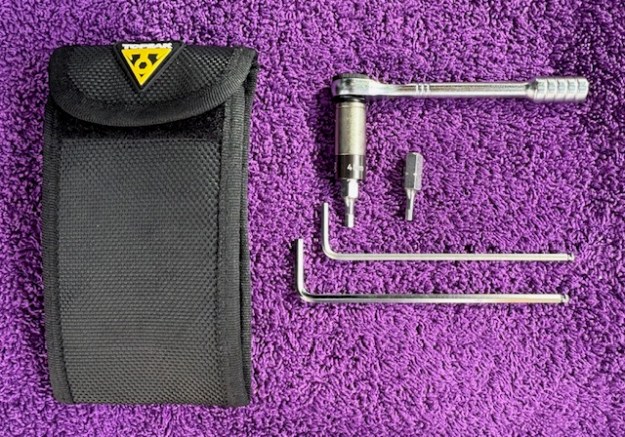
GH was careful to tell me to be very wary of over-tightening the bolt. I’ve been using simple hex keys left over from my cycling club days – nice ones with those round “any angle” ends on them. On the wide side, there’s about a 75mm throw so maybe the available leverage is a bit high. (See photo above). Too easy to over-tighten.
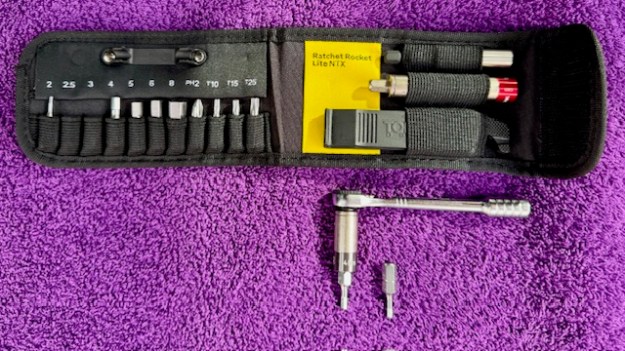
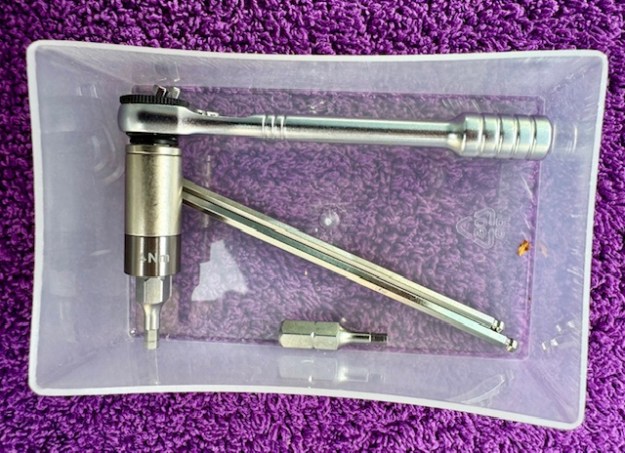
GH recommended one of those T-bar hex keys. However, as I dipped into the old race bike tool box I suddenly remembered I had a mini ratchet/torque wrench from a brand called Topeak (very big brand in global cycling). It has 2.5 and 3.0mm keys in the selection. The torque heads can do 4,5,6nm of measured torque, but I feel that even 4nm is a tad much for the Marblehead fin. However, as you throw the lever you can easily feel the “bite point”. Simply to provide shaft length to clear the deck well around the mast, I have the 4nm head on there in the photo (above), but have never let it “click”. If you look carefully at the top photo you can see “4nm” engraved on the shaft extension.
The ratchet on the handle is a dream for putting our long fin bolts in and out. Love it. Plenty of space in the tool box too. It comes with a little pouch, but my preference has come to be keeping the subset I need in a neat translucent plastic box – which turns out to be an old business. card box. I knew I’d find a use for those one day 🙂
The whole thing will be great for the Ten Rater (of my dreams) too !
You can see the current product on the Topeak website at this link below. Even better, the current product has 1-6nm of torque adjustment, an improvement over the 4/5/6nm set that I have. Click here:-
I managed to get my hands on one of these a couple of days ago. From the airplane and gliding world, the FrSky Tandem X20….. Bit of a wow. It was interesting to see what they use over in flying.
They cost about double (450GBPs) what radio sailors would think of as “pricey”, but can you tell the difference?
Amazingly – a resounding “yes”…. the feel was a huge step up from what we are used to. The body was a lot more solid (alloy maybe) and interestingly weighed about 900g so a bit heavier than common radio sailing transmitters. It felt very good in my size/shape hands. The “Apple” of transmitters maybe.
Gimballs (“Hall gimbals”) very smooth and more central on the console which somehow gave a nice balance (nearer centre of gravity perhaps) while you used it. Thinking about it more, if you move the screen to the top of the unit (most of our transmitters have the screen at the bottom), you can then move the gimbals down lower on the console itself.
Another thing I noticed was that the gimbals can be rotated slightly for those in search of more comfort over longer periods. Somehow, the whole thing looked more showerproof too. Really tightly fitted together.
When we decided to write the radio sailing manual for Radiomaster transmitters, I came across FrSky because the previous range FrSky along with Radiomaster use the same OpenTX software. FrSky seem to have abandoned that OpenTX strategy now as it was holding them back. They have done their own modern looking operating software called EthOS. That’s amazing too – it’s like having a full iPhone aboard, …all icons, colour and sexiness. Lots of preloaded configurations for power mixing and the like.
I might have misunderstood, but the owner said you could send updates (like custom model configurations) to it “over the air”…. so he can swap configurations with friends very easily.
The owner of the unit that I tried was a Competition Gliding fan. I asked what he used previously, and interestingly he had a Spektrum DX6E – which of course is very common in sailing.
Way over-configured for the needs of radiosailing, but it was interesting to see what £450 would buy you.
Last weekend was the third in a row where we have had a member’s boat drop radio signal while racing. First up was Hugh’s F6 – turned out to be battery, then my IOM – turned out to be the on-off switch, then last Sunday it was Jim’s turn in his F6. Not sure of the cause just yet….
It’s pretty natural when the transmitter loses the boat that our first reaction is to stare at the transmitter and growl loudly at it. The thing which you drive the boat with… using your highly skilled hands , just went dead on you, ….right there in your snug, and at a critical moment….. Natural reaction…. Grrrr
Have you considered it might NEVER be the transmitter’s fault?? These things after all are just solid state lumps of technology.
Phil has a great story of losing signal to the boat with a Futaba. Then he discovered that rotating the transmitter vertically, so that the aerial handle was vertical, caused the boat to reconnect and take off again. Interesting, but the weak link might still be at the boat end of things, ands not the transmitter in one’s hands.
Well probably not “NEVER”…. However, chat around our club members in the clubhouse and everyone has a horror story about every single transmitter brand, and it usually ends up “I had to throw my Spektrum/Futaba/Radiomaster/Flysky away….” (delete as appropriate)
So I came to thinking it might never be the solid state (not much variability) transmitter kit we all know and love. It might be the other end of the signal – the receiver in the boat that is the most common cause. We all spend a tad less care, money and attention on that.
There are a couple of very topical “antenna-less” receivers used at our club. First off is the Spektrum AR620 which is praised highly by Rohan and Craig (who gets five votes anyway!). No dangly wires causing variability according to way the way you chuck them in. The little built in antenna is designed by Texas Instruments. They say it gives better range than …. well, better than what? Better than their wired antennas, but we have no measure of them, do we??
Phil uses a similarly stunning wire-free ELRS antenna on his Radiomaster setup. Very strong performance I’d say. No drops yet. These wire-free antennas are about the size of a sugar cube, so it’s mind boggling that they can have better reception than lengths of antenna wire, but listen to the video above about the AR620
It seems to me that the key point is that they are going to have minimal variability from one outing to the next. VERY solid state. If it works well, it’s going to work well every time out.
By the way, next time you hear a “I had to throw it away” story, try and remember to ask if the boat hull was carbon fibre or fibreglass. Honestly – if you google “carbon fibre radio reception” you get simply hundreds of articles basically saying that carbon fibre near your antenna is never going to improve signal. It will quite probably weaken it – though not block it entirely. Would we know??…
I’ve a sailsetc type plastic pot for the receiver in my carbon F6 and I think I’ll do the same in the next F6.
So – we have wire-free good sounding receivers in Radiomaster and Spektrum. Futaba don’t sell one yet, and if you have a futaba you will be on dangly wire receivers.
If you are male and married, do you get this thing at home from the Steering Committee about women always read instructions and men never do?? … I know, I know…. me too.
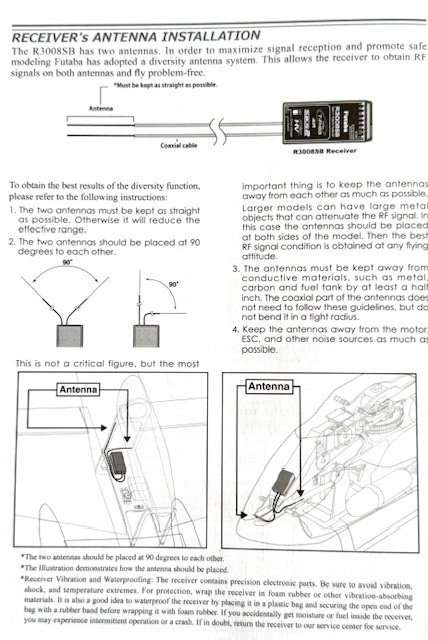
This is the Futaba manual page about wiring their receiver antennae. I’d swear I knew all that, but when I just checked the F6…. well maybe I was not quite as thorough as I thought I’d been.
First up, we will all have fellow competitors who just bung the wires in the pot and get on with it. “Makes no difference”, (sounds like me) but actually maybe we never really sail much near the edge of range. I’m a bit like that, with a slight tendency to buy a gadget to cope with it – in my case a Sailsetc antenna frame – but as you will see, I still got it wrong.
The futaba manual is very clear that the antenna is mainly covered by a coaxial sheath ( I thought it was just a plastic sleeve). Only 1-2″ of bare antenna is exposed – and it’s those bare tails that are best fitted at 90degrees to each other. Both their examples in the manual also show that the antenna tips are ending up far apart. With the Sailsetc frame, you can thread the wires so that the tips come together, OR are far apart…. I confess, I thought the wire was in a protective sheath and just exposed at the ends. So I popped the whole sheathed antenna through the 90 degree Sailsetc frame….. WRONG, and NAUGHTY BOY!! The manual is very clear – only the exposed tails should be at 90 degrees.
You will also see that my antenna on a 3008SB receiver, first have a coaxial sheath, then have a rubber seal (not shown in the manual) and then only about 7mm of exposed wire. So I assume the rubberised length of about 50mm WILL receive signal.
I have rethreaded it and it now looks like this….
I’ll only know if it’s effective if nothing ever happens….





 Datchet Radio Sailing - Making It All Much Easier !!