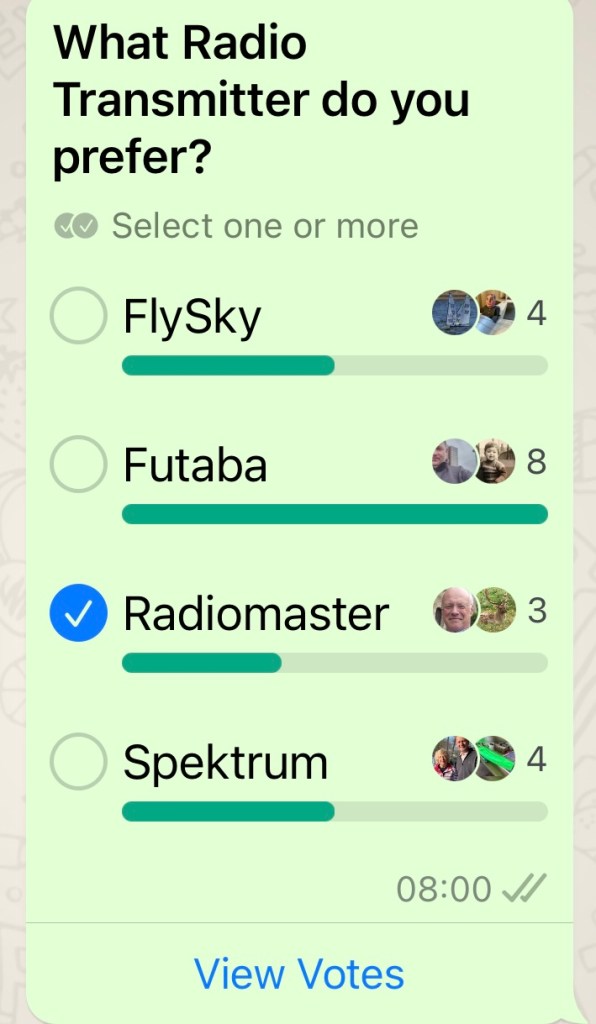
We had a super flare-up on our WhatsApp Group this week about radio transmitters! There’s real passion out there !!
Reasonable reactions …. as for all of us, the transmitter is your primary interface to the boat. We all have different size hands, different feeling at the fingertips etc etc. It’s good that people have strong views!! Don’t mention purchase price to a group of radio sailors, or you’ll never get away. (!)
It’s clear from our WhatsApp chatter that every transmitter brand has both war stories and accolades in good numbers. For beginners, I’d say the stories (good and bad) just make choosing your first transmitter much harder to work out. Oddly there’s almost no way to compare how the various models feel in one’s own hands – big/small/balanced etc.
As a result of all the messages I posted the little poll above – half the members replied in about three hours, so we have touched a nerve!! Interesting result above, actually….
I’m thinking we might run a “Transmitters for Beginners” section here on the website, as understanding all of this area is a significant barrier-to-entry for newcomers. Very daunting,… speaking for myself anyway. It need not be, if we can demystify it. If you buy a second hand boat as your entry to radio sailing there’s a high chance that it comes without a radio. So the beginner hits this wall straight away.
There is limited help on YouTube for radio sailing beginners (excepting FlySky to a degree) and they all have dreadful User Manuals… or no manuals at all to speak of.
The radios are all built for the market as a whole. The market for transmitters is dominated by planes, cars, drones, gliders and the like. At MYA we have a little over 2,000 members… you’d think that was a lot. Do you know how many drones are licensed in UK as at 2023?? 513,000…. Mind boggling. Furthermore, the needs of planes, drones etc means that the transmitters are way over configured for what we need. Radio sailing needs only a tiny amount of the functionality that the transmitters deliver.
So, if we are going to get the help and manuals for beginners sorted out, it will have to be radio sailors that do it.
Three of us defied our families to sail M’s today!
Graham had his new F6.2 out for the first time and showed great speed, Jim borrowed my F6 and I sailed the Niou-Niou.
The wind varied from bottom to top of A rig with some pretty big swirls as it made its way around the clubhouse but we managed some very close racing even though Jim couldn’t get used to the length of the Marblehead fin when passing marks he quickly got to grips with the boat and came out eventual winner.
I’ve only been radio sailing a short time, but I’ve already had five chargers in the house. Or is it six? My wife thinks I am/we are mad. However, it does give me a disproportionate amount of experience in the matter (ha!).
Let’s start with safety though. It appears that LIPO batteries in particular (see earlier articles) cause some safety concerns and prime among them is what happens if they leak, or overheat, or leak and overheat. There is honestly a lot of opinion written about this online. I feel my own summary is that your batteries can leak and become dangerous from three or four main reasons:-
physical damage, bumps, abrasions etc (check them visually regularly)
exposure to extremes of heat or cold (so don’t let it happen)
over charging (includes left on the charger overnight – my favourite)
amazingly, apparently letting the charge drain to nothing also can cause problems
What do you think? It seems to me that at least the first three above are high in my mind, but surely the most likely thing I am going to experience is over charging, or perhaps charging too fast (too high a current included).
So we have had five types of chargers here in just a few months. Let me deal with that. Firstly, rechargeable AA batteries for the transmitter. Well you could simply always carry a spare pack of duracells in your pocket, but I disposed of the first charger because it had no display or coloured light system too show when your AAs were fully recharged. So now, I use one with a display that shows you the state of charge in each cell, plus flashes at you once it hits full. It’s a pity they dont beep when full as well. From Amazon, not expensive, and great. It came with fresh AA’s I think. It can charge different sizes too, and variable battery numbers.
Now… on-board batteries ….. much more interesting….
You need to read up about balancer cables and balancer charges. Basically, if you just charge via the one main connector, in a two cell battery the first cell hits full before the second cell. It obviously leads to all sorts of inequality but notably the first cell will tend to over-charge and over-heat. So get a charger that supports balancer leads.
In my short time, I’ve had LIFE with JST connectors, LIFE and LIPO with XT connectors. The first charger I had for the JST batteries, was frighteningly crude. You plugged the battery in for hours, and it never seemed to charge fully. It had one red warning light. It was with the Club loan boat – I threw it out and bought them a new one.
My brand new IOM came with LIFE batteries XT60 connectors, …big ones. The charger had balancer leads (the little white things with three holes), progress lights in red and green, so somewhat more informative. It had no indication of applied current though. I think it did one battery at a time – I’d have to check. Then I got the Marblehead which came with XT30 connectors, …the mounting variations made my head hurt. I have a mix of LIFE and LIPO for that boat just so I can make my own comparisons.
So what to do?… Consult an expert…. I paid a visit to the fabulous TJD Models shop in Sutton at Hone, Kent. (near M25 and close to RC Yachts, home of the DF95) Not sailors, but drones, planes and race cars is their thing. They were magic. Seen it all before and knew the questions to ask.
First question was all about connectors, and the second big discussion was about charging current. He asked what m.a.h. batteries we use in sailing. I said (guessed) 1000mah to 1800mah. He said, always charge at 1 amp maximum else they get hot. His simple rule was to show me a 1500mah battery on his desk and cross out the last three digits and you get a “1”. Use 1 amp was his strong recommendation for both longer life and safety.
Then he asked about budget. I’m sure you can spend a fortune, but his product shelf went from basic to intelligent, and £25 to £50. What price safety? I know £50 is double £25, but honestly around here that’s about 6 cups of latte. With their help, I chose a charger model around £50 (a bit less I think). I bought the SKYRC 100 intelligent charger in the photo above. I bought two eventually – one for the loan boat and one for me.
For your £25 extra, what do you get?
-firstly it has separate charging regimes for LIPO LIFE and about three other battery types, I’d never heard of. So I share my one charger across all boats and batteries now.
-when you plug in, it checks the battery type and tells you what it thinks you have got, so the user can check for mistakes.
-you select the amps going in, the number of cells, the target volts you want, and it displays all this all the time during charging. You particularly see the current amps fall as “full” gets closer.
-when it detects “full” it turns off the current and beeps like hell at you to come and unplug everything. You can hear it from two rooms away. I love it. I disconnect straight away.
-it has balancer lead support and refuses to start unless you plug it in. Good.
-get this, it can charge two battery types! I have it set up to do XT60 in one socket, and XT30 in the other. (see photo). I’ve not thought, but it probably can charge two batteries at once (I’d have to check)
For my batteries with JST, the lovely TJD Models Shop made up an adapter lead while I waited. For XT30 (my marblehead) batteries I bought this little bag of adapters for about £5.50 on Amazon.
So there we are – do what you feel is right. I wanted to feel good about managing my risk, and for the moment this charger plus fire-proof bags seems as good as it gets. To charge I place the SKYRC unit inside the explosion proof bag (fits nicely) and charge inside there. The cable goes in through that little trap door flap in the side that you can see here. Easy…