Tag Archives: radio sailing

Beginner Guide to Transmitters : Upgrade to our Futaba Manual….. Using P.MIX mode ….!!

At the weekend race session, two things came up which prompted this update to the Futaba Radio Sailing manual.

The first thing : Some time ago, Vernon suggested taking a look at the Futaba model 10J transmitter. For the cost of about 25 flat whites (£100 or 50% more than normal) you get a big upgrade to aesthetics, robustness (waterproofness maybe?)… and the way it physically handles – it’ll be a personal thing I realise. But I was smitten…. It felt great in my hands.

However, at the time of writing the 10J model is populated with mainly two position switches. It has one three position switch on the right hand side.

We have been trialling both rudder expo and “Pinch and Puff Mode” using three position switches. The models 6, 12, 16 and 18 have all had their switch inventory updated to three position switches. I don’t know if the same will happen for model 10J. You’d think it will follow the rest.

Since setting out to write a radio sailing user manual for each of the main transmitter brands – Spektrum, Futaba, Flysky and Radiomaster – I have become quite interested in the idea of how to use the transmitter to ease and maybe speed up the personal transition for a beginner to radio sailing,… from sailing to radio sailing.

Some of the things that a beginner finds hard to do quickly enough in their hands and head at first, can be done by the transmitter instead – just while you learn. I am thinking of rudder expo, mainsheet curve (aka Throttle curve) and “Pinch and Puff” modes. Usually I tell people that the transmitters are pretty much the same, but in this regard they have varying capability.

My Spektrum will be back from the Doctor soon and I shall get on with producing the full radio sailor manual for that. At the present time, this website has a download pointer to the American MYA manual for the Spektrum DX6e.

The second thing : on Sunday, Nigel’s fabulous blog published an item on how to install “Pinch and Puff” mode using a Spektrum and implementing it not with 3-position switches… but with the left joystick. Clever. I’ve just set it up on the F6 Marblehead to test it.

The Beginner Guide for Radio Sailors on setting up the Futaba to do sailing P.MIX has been updated to include this great idea. Model 10J owners, take notes!!

Click here to see version 9 of the manual

Sunday 7th July at Datchet – Saving the Launching Platform…!!

Unexpectedly we had rather a great day at Datchet on Sunday. So many people are racing away, we only had four Marbleheads out and the weather was a challenge. (I did discover embarrassingly that my shorts go transparent when drenched by rain… 😦 … twice…)

We had B rigs on, did maybe five races or so before the strong breeze collapsed to zero. We invested in more tea and coffee, but actually the company was great and the chatter even better. For myself, I needed a fair bit of advice (tacking in a breeze without coming to a dead halt!) and my fellow club mates were falling over themselves to help.

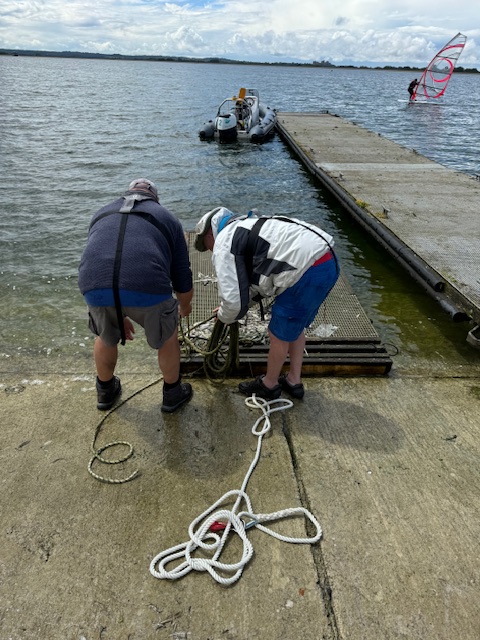
Club management was quick to point out that we had lost one of our two launching platforms in last week’s summer gales. Impossibly the platform started life to the north of the RIB pontoon, and ended up rammed and jammed under the south side. A mystery that is.

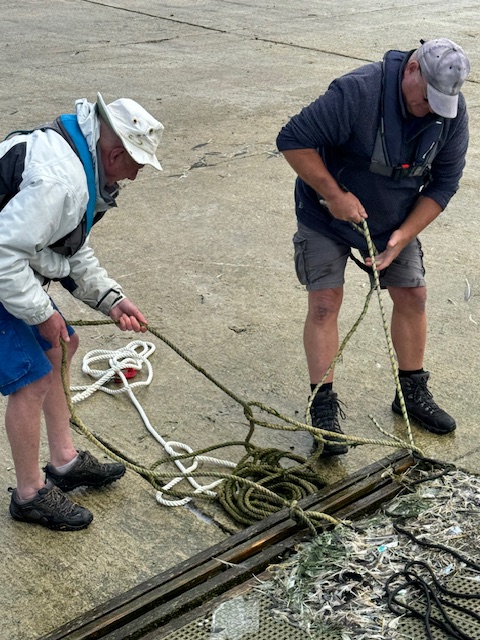
Two of our amazing radio sailors immediately piled in and dislodged the thing… wrestling it to the shore. Next Job was to haul it out of harm’s way with the Club Jeep.

A roller wheel has parted from the leg nearest the camera. However, our Sailing Secretary has recovered it from further around the bay. It looks repairable.

Great news!!

Cord Sizes – What to Carry in Your Tool Kit !!

Rather impulsively, in 2023, I decided to make a move into Radio Sailing. Practically nothing worked in my big boat toolbox for this part of the sport. Evidently none of my (huge) string and cord collection was going to work . In the flash of the moment I acquired a reel of dyneema to be ready for anything, or so I thought.

That’s it in the photo above. The experienced amongst you will spot my error straight away. It’s a 300m reel – that’s enough for a whole club fleet to use for a hundred years.

It is also 4 braid which gives it a slightly lumpy appearance – I know now that SailsEtc recommend 8-braid lines.

If you have come to radio sailing from another branch of sailing, you’ll realise that you use different size and strength lines for different jobs on the boat. In your first encounter, you may think that all the lines we use are the same size (small).

Not so – explore SailsEtc and try looking at the Sailboat RC website. Sailboat RC carry a stock of four grades of lines – if you buy from them, they come on different colour spools about the same diameter as 5p piece or smaller. In a crowded tool box that’s a good idea, but I’m also thinking is using different colour lines to indicate diameter or strength is a good way to go – see SailsEtc.

This is what Sailboat RC says:-

GREEN spool   0.25mm 18.5kg Topping Lifts

BLUE spool 0.30mm 36kg   Main&Jib Sheets

LIGHT GREY spool 0.70mm 60KG  Drum Sheets 

                                                                        &Jib Foot to magnet    

TRANSPARENT Spool 0.70mm 30kg Rigging all round

The diameter is interesting, but not half as interesting in the line loads indicated for each job.

Generally speaking they only put around 5-10metres on a spool, and frankly that would last a club sailor a lifetime. At that size, you can tuck them anywhere in the toolbox.

If anyone needs 300m of dyneema, give me a call!!