When we launched the Datchet Radio Sailing website in late 2023, we had an eye on trying to reduce the inhibitors people often feel when they get into radio sailing.
A few “Beginners Guide” manuals were created as downloads, mainly for radio transmitters, but also the likes of installing new winches (very popular!), diagnosing problems in the electrics, installing new transmitters and so on.
The response has been amazing. In a few days time, the radio transmitter global downloads of the manuals are going to reach a total of 1000. It’s 985 downloads as I type (August 2025). Of those, about half are for the Radiomaster – interesting.
The beginners guide on how to fit a new winch has, alone, been downloaded 255 times. How to install a new transmitter has been downloaded 72 times.
The Futaba and Flysky manuals are about equally popular as each other – Futuaba slightly more so.
I have a Spektrum in the workshop ready to install on a Proteus IOM. I had a plan to produce a manual for that also (one day … takes a lot of time). In the meantime, there is a link to an excellent radio sailing manual for the Spektrum DX6 on a US based website. If anyone wants to give a hand with that, don’t hesitate to get in touch.
Do you think radio control aircraft flyers ever get cold hands?? I’m beginning to wonder…
Maybe they don’t!! Radio Sailors on the other hand usually do want some warm, dry, hand protection and it’s extremely usual for us to use “Transmitter snugs” to keep our fingers warm !!
Our transmitters are generally model aircraft transmitters and we use a tiny proportion of their capability in Radio Sailing. Not all of them come with switches for aircraft pilots to play with, but the more you pay the more switches you will see on there. Lets be clear – far fewer radio sailors use ANY of the switches, but if you find yourself tempted quite possibly your transmitter is festooned with the them..
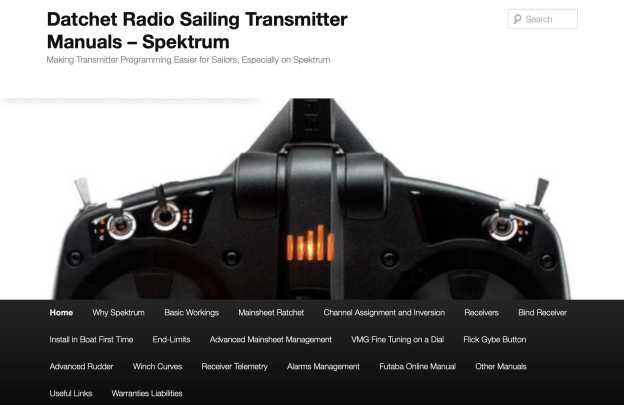
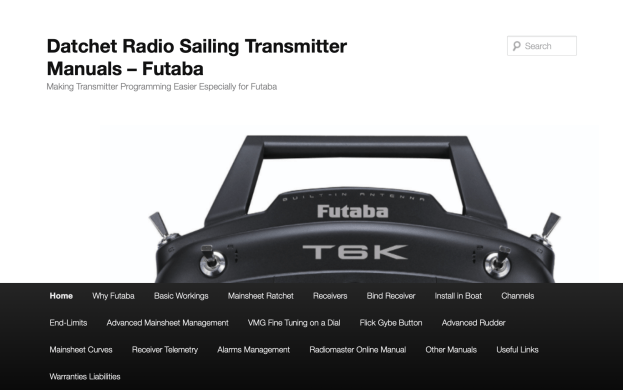
By “switches”, I am referring to those little silver spikey things such as the ones you can see in the photos above. If you are tempted to try one of these switches for sailing, then read-on.
In way of a suggestion, consider whether when inside a “transmitter snug” the switches can get inadvertently flicked/activated by the very material that is keeping your hands warm. Certainly when you take your hands out of the snug and perhaps place the transmitter to one side, you are open to this happening.
It won’t happen on the Radiomaster Pocket (switches safely recessed) but Flysky, Spektrum and the Futabas generally have them running along facing you on what I think of as “the top” …. meaning the console where the joysticks are located. Futaba and Spektrum also have switches on the back panel, slightly hidden away from you. To make it more interesting there are often two different switch arm lengths. What I have been finding is that the longer switch arms (lovely action!!) are the ones that can snag on the inside of the transmitter snug. When it happens, it’s quite difficult to spot until something doesn’t work on the boat as you expect…. usually at a crucial moment!!
The Flysky I tried at the weekend additionally needed those switches all in the off position just to power up successfully. The Flysky only has switches along “the top” if I recall correctly. (see photo above)
So my suggestions if you really, really want to try switches would be :-
1/ Choose the short stubby switches if you can, as they are often “protected” against snagging by a tall switch located next to them.
2/ Consider only using short stubby switches on the back panel if it fits your way of thinking. A reduced chance of snagging back there….
3/ If you get cross, don’t throw away that transmitter snug!!
Have you seen all this kit photographed side by side before? If not, read on… Four transmitters here. (Comments included below about Flysky, which I installed at the club today)
Whenever I find myself in a discussion at the Club about selecting a transmitter, I always say it’s a very personal choice. Figure out what works best for you, not what I, or anybody else, would recommend. We are all different. You’ll use these things for a long time, so choose with care. The big brands all work, all have success stories, all have horror tales (undated!). Figure out where service and support can come from too.
(Photo 2)
So I always say, “We all have different sized hands and fingers, you have to go and compare them, FEEL them in your own hands”. It’s not that easy to arrange though, is it?? Not even at a model shop. Really you need to line them up and pick them all up for a good “feel” in about a 60 second window. I don’t know why I hadn’t done this before. You form impressions very quickly.
(Photo 3)
How do you measure hands anyway?? Tape measure? Glove size? I do it by people I shake hands with. You know pretty quickly if the hand you are shaking is smaller/about the same/larger than your own hand. I reckon my hands are quite large and on the 75th percentile in my handshaking experience. My domestic Steering Committee though has very delicate lady-hands and surprisingly she offered to help on this exercise this morning. The amazing thing was that in the end we came to the same opinion, hand size variation or not. In this house,…. that’s unusual on any subject!
(Photo 4 – like something from Gulliver’s Travels)
This is frankly very difficult to arrange on a Club race day. I suddenly realised that I have four of common models here in the “lab”. Only Flysky is missing today in this measuring test, but the rest are here. Last Sunday, I installed Howard’s brand new Flysky on his IOM. Interesting for me – I didn’t have the scales with me, but comments about the way the Flysky “feels” are written below.
I’m spurred on by the fact that I have a new boat coming this year. There is a need to figure out my radio strategy.
The “How Do They Feel in The Hands” Test
I have here today, a Radiomaster Pocket, a Futaba T6, a Futaba T10, and a lovely Spektrum DX8e. You can see all their photos above, side by side for comparison. Zoom in !!
They can all do the job, but how do they feel?
Size andWeight
First surprise for me. The DX8E is really by far the largest here height, length and breadth – plus it has the spike antenna sticking out (which by the way, can hamper picking it up single handed by the lifting handle). I hadn’t realised how much bigger, but when you handle them all in 30 seconds it’s obvious. One for big hands perhaps. However, it is NOT the heaviest.
Radiomaster 400g
Futaba T6 650g
Spektrum DX8e. 700g
Futaba T10 750g
Next surprise : that Futaba T10 is smaller, possibly more modern, denser tech than the T6…. because it’s maybe 10%+ heaver than the sister model, but really surprisingly 5%-10% smaller in most dimensions. Noticeable in the way it feels ….
(Note also that the two Futabas have distinctly different size antennae modules – you can see in the photos. I assume the T10 is a newer, next generation, pricier antenna, …more modern tech that performs about the same but takes less space. I’ve searched for antenna specs for these two models to see if they perform the same, but have not found anything so far. Let me know if you find them. In the end, the Spektrum antenna spike is probably about the same order of size as the Futabas, which is no measure of performance. Sticking out at a right angle does make a difference to shore side handling though.)
Bench Height
As you’d expect, when laid flat on the bench the Radiomaster is the lowest height here.
Perhaps more of a surprise is how that dimension on the T10 is noticeably less than the (older tech?) T6. Photo below…
I thought I had long-ish fingers, and when I pick up the transmitters in two hands (I.e. normal handling), my fingers have to curl away and park themselves somewhere. It’s about personal comfort and you will be different to me. Unexpectedly, the largest finger “wrap around” dimension (DX8E) was for me not the most comfortable. The Radiomaster was a bit small for my finger wrap-around test. The surprise for me was that the smaller T10 seemed a more comfortable fit in that regard than the T6.
Flysky:
As written above, I didn’t have the Flysky with me when I tested the others at home, but I did install a new one last Sunday on Howard’s One Metre. It’s more compact in my hands than I remembered …and lighter than I remembered. I’d say in physical dimensions improbably sits in between the Radiomaster Pocket and the Futaba T10J. Weight-wise … hard to say without the scales but it seemed quite like the Futaba T6k weight to me. The cabinet of the unit is a little more angular, less curvy than some.
Balance and Centre of Gravity
This was spotted by my dearest with the small hands. More of an observation than a showstopper….. The centre of gravity of these units varies quite a lot and changes the way the balance feels in your hands. Important? Probably.
I’ve spoken to a competition radio control glider pilot about where they like transmitter centre of gravity in their sport. He says a general principle is that they like the centre of the gimbals to be at the centre of gravity – to give it a more balanced feeling when they fly. So as a result the top transmitters that they like look slightly as if their gimbals are a bit more centred than we might be used to. Try googling for a picture of a FrSky X20 transmitter and look at the gimbal positioning.
The DX8E feels like most of its tech is under the screen and the rest of the box is empty. The natural way for my wife to hold it was at a 45 degree angle with the edge closest to her being the lowest.
The next one feeling that most of its lump of technology is centred nearer one’s body is the T10. It’s not as marked an effect as the Spektrum, but it is of course just slightly heavier.
Those are the two heaviest, so you might expect them to stand out for “balance”…. the Futaba T6 is very light actually …and the Radiomaster absurdly light.
Do you want “light”?? I’m less sure than I was.
Flysky : I’ve no data about balance and centre of gravity, but it felt very good.
The Immeasurable Feel, Sturdiness or Robustness Impressions
We hang on to our joysticks, don’t we – are you a thumber or a pincher?? I don’t know how to measure the way the joysticks feel, but these four are different. Try them and see. I tried two Radiomasters last week, one with normal gimbals under the joysticks and one with “Hall Gimbals”. I could certainly tell a difference, but I think you just have to feel for yourself.
Strength : Honestly – I think you could throw my Radiomaster over your shoulder and it would bounce and be fine. Amazing robustness.
The Spektrum manages to feel really robust in a strong thick plastic kind of way. Yes it does feel sturdy. It has a textured surface too which maybe helps this impression. A small thing, but the DX8E battery compartment feels the best here.
So that leaves the two Futabas. How can I explain this? They don’t feel flimsy or weak, but in a blindfold test I think you’d mark out Spectrum and Radiomaster as somehow feeling more sturdy than the two Futabas. However, something else is going on here too…, the T10 feels more …. sexily finished. I can’t describe it, but somehow in your hands it feels more – oh I don’t know. It’s very clever, and the Steering Committee agrees. There’s just something more sophisticated about the way it is finished and feels. I’m not going to do all this again with wet hands and see if it comes out the same, but you’d have to wonder.
Conclusion
This is an exercise that’s really worth doing for yourself sometime. Maybe I should take all the transmitters to the AGM for a group test.
There’s a bit of a price war going on. The Spektrum DX8E was the priciest half a year ago, now it is very competitive for radio sailors as the DX6E. Likewise the others also seem to bob up and down on price but the Radiomaster Pocket is always an amazingly keen price. Maybe when the ship from China has just docked, stocks are high, prices are keen.
My Steering Committee said that it was typical that the one I choose for me happens to be the priciest !!