
I suppose as a complete beginner, it’s natural to feel that it’s going to take a lot of racing before I get to move from back of the fleet to the middle !! “Started too late in life” is the key learning. Instead of waiting to end my keelboat racing then switching to radio sailing, I should have overlapped these two forms of sailboat racing – for about a decade!! One of the charming things for the beginner is to see fellow club members peering knowingly down their masts, flexing their back stays with their thumbs and watching their leech twist. It all looks a bit like black magic!!
The boats all come with a tuning guide of course. I must admit that I found the BG Tuning Guide very insightful. All the measurements are there, but when you watch club members the whole thing is a pretty “analogue” process. I’m surprised in a way because in dinghies and keelboats, calibrating your boat and rig is simply de rigour. Everyone does it.
I suppose if you cast your minds back to Flying Dutchman sailing in the early seventies – Rodney Pattisson, John Oakley, Keith Musto and all that – we get to realise that calibrating rigs and boats in sailing was just starting to “arrive”. I used a Club loan IOM to get going in 2022 and 2023, and was lucky enough to receive a new IOM just recently. It’s a very polished product – complete and ready to race out of the box etc – and I’m delighted to see some calibration in evidence. Someone, somewhere is thinking about this.
These are the first two things I notice on this IOM.
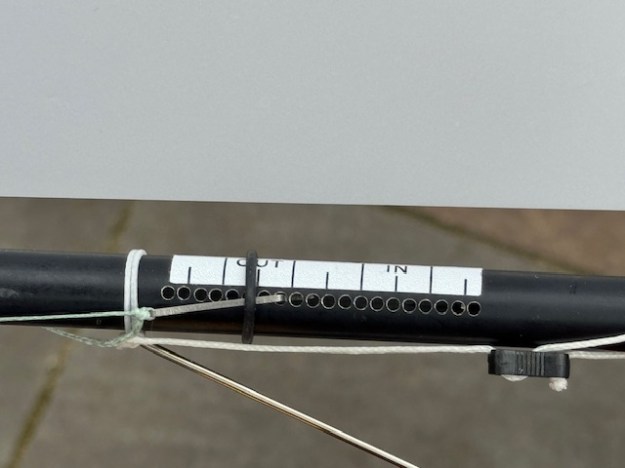
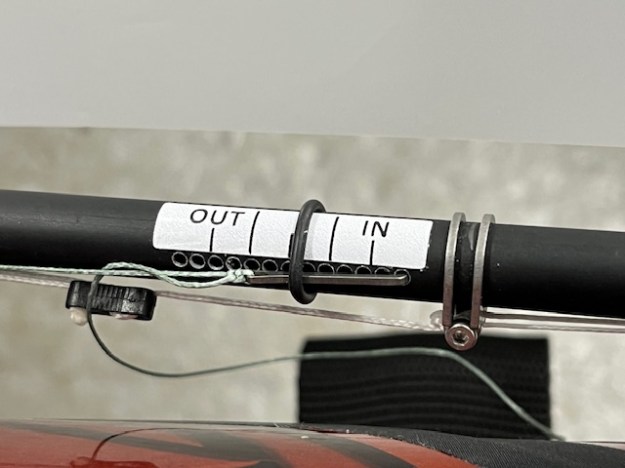
This is the arrangement for calibrating main and jib sheet adjustments. No bowsie, but instead hooks in a rack of holes. Comparing this with the other boat I have – which just has bowsie adjustment – this is much, much better. Precise, visual, repeatable and very easily changed. I cannot be the only beginner who finds adjusting with a bowsie means you go too far, not far enough, have to move your hands away to see what you’ve done, not measured etc. This is just much, much better. Very grown up.
Remember – bowsies can slip under load (see SailsEtc article about tests on this). This hook and rack method will protect you against that.
How do they drill those holes in the spars though?? I dare not try – I imagine it needs a carefully calibrated drill jig or something. If you know how it’s done, just leave a comment on this website entry.
Without the rack of drilled holes, even simple calibration tape so that you can read where your bowsie is, would help a lot. I’ve ordered some calibration tapes from SailsEtc to see what they have in stock that might help. However, narrow strips of tape with simple markings would help see where you are. I’m using it a lot on the IOM already.

At the factory, the supplier marked up the back stays with two black dots to correspond to their recommended measurements. It’s good and I am trying it on other lines. Just line up the dots and that’s your starting position. I should maybe refine it so there is one red dot, and on the other line a row of dots maybe 5mm apart. That might work. It’s simply to help the learner find the “starting point” each race day before detail adjustments inevitably follow.
Note to self – make sure tool box has ultra fine permanent pens in both red and black inks.

 Datchet Radio Sailing - Making It All Much Easier !!