Tag Archives: marblehead blog

Beginning to Radio Sail? Which Stand Design Do You Want? … Well, Where Do You Park the Car?

Sometimes, I think my brain is really slow….

I have a couple of aluminium type stands in the house, and I’m hoping for another one quite soon. You know, nice clean aluminium legs with straps for the boat hull to sit in. You see a lot of them around.

Then I was down at my Wednesday club and decided to help a pal who was moving from car to shore for the race session. It’s about a 200 yard walk. You have to carry your transmitter (round your neck), the boat, maybe your rig bag, and the stand… plus in his case a chair to sit upon during racing. It’s a major feat, let me tell you. My friend left me carry his easy chair.

Then it occurred to me that on that IOM race day, nobody was using an aluminium stand. All the competitors had wooden stands, some of them just fantastic pieces of beautiful joinery in their own right. Gorgeous.

It was only then that it occurred to me was was really going on. On all these stands there was (i) an integrated carrying handle – see the black bar in the photo above (ii) the boat could be strapped securely to the stand. ….. When walking from the car park to the shore, you need one less arm. You simply pick up the stand by the handle and the boat gets a safe free ride.

There were interesting variations in keel supports (see above) ranging from velcro straps or bungee cords, or in one case a U-shaped keel support which would have its merits.

We have published links elsewhere on this website (see the Category list and select “Stands”) with plans for wooden IOM stands like this.

When the weather warms up, I might have a go.

So the answer to “What type of Stand do I need?’, might just be, “Where Do You Park?”

Starting to Race – Would a Personal Handicap System Encourage You?….!!

This radio sailing sport can be a little daunting to get into, don’t you find? Quite a few barriers to entry !!

Honestly we occasionally get days when the person at the front of the fleet seems 10-15% faster than the group of boats at the back. It feels like there’s a decade of apprenticeship ahead – ha ha !!

Are you a golfer? It’s not unknown in other sports to have personal handicaps and for all the right reasons of encouraging the newcomers. Certainly in the Flying Fifteen keelboat fleet we have had personal handicap programmes in the past and they are currently trying dividing the fleet into four groups – gold, silver, bronze and standard with scoring and prizes in each sub-fleet. You have to minimise admin though.

Surprise, surprise ….!! There are plenty of radio sailing clubs experimenting with the same idea. If you go this way though, your Club needs something with minimal overhead for the Fleet Scoring Rep – something very light touch, with almost no work!!

If you have used the MYA HMS Scoring system, you’ll know what I mean!

Here’s a couple of ideas that have come into my inbox in the last month:

From Club 1:-

The two main handicapping methods used for radio sailing are a) apply an adjusting factor to the helm’s results or b) stagger the individual start times.

1. Method a) requires no change to how races are run so the finishing order can continue to be used to produce the results in exactly the same standard scoring format as at present but can also be used with additional calculation to apply the handicap factors and tabulate the results in the alternative handicap scoring format. 

2. Method b) involves a staggered start time sequence, i.e. yachts start at different times based upon a handicap rating, the idea being for all yachts to finish at the same time. The  finishing results as recorded are already in handicap format without further calculation. It does mean however that the finishing results are not useable for the standard scratch series, consequently this method requires separate races to be dedicated to run on a handicap basis. 

3. Under Method b) a dedicated handicap 5th Series might be run in parallel with the other four standard series, e.g. in a calendar period of 13 weeks there could be say 10 standard race mornings and three dedicated handicap mornings which would count towards a rolling annual handicap series. This would give four standard scratch series as at present (but with 10 results in lieu of 13 in each as has been suggested) and one annual handicap series with up to 12 results to win the Handicap Champion of the Year trophy. 

From Club 2:

Then there is the well proven system at Guildford MYC:-

If you have any thoughts or experience in this area, please leave them using the “Leave a Reply” feature at the top of this news item.

How to Neatly Finish Your Rigging Lines

When you get your first radio sailing yacht, inevitably when you look around the rigging, you are going to wonder how owners very neatly finish off their lines with a very abrupt knot

If your mainsail is secured to the mast via fine rope eyes, take a look at how they are finished. Let yourself wonder, “how do they do that?”

I borrowed an IOM to try and get started, and had to ask the Fleet Captain how it was done. He used two basic bits of kit.

1/ Put an overhand knot to finish the line/lines. It’s easy to slide an overhand knot along and get it in exactly the right place.

2/ Use Superglue over the knot head to LOCK it down. Wet your fingers first – you don’t want to end up glued to your IOM or Marblehead, like one of those ‘Stop Oil’ protestors. Let it set.

I bought from WH Smith, this pack of three mini tubes of superglue. I reckon if you buy a single larger tube, one day you’ll be desperate to use it and it’ll have set like a rock or just gone off.

3/ The next challenge is to remove the tails on the other side of the overhand knot.

If you cut with a scissors or knife, it just won’t be perfect. It might even wriggle out of the knot over time, or leave a fraying end line.

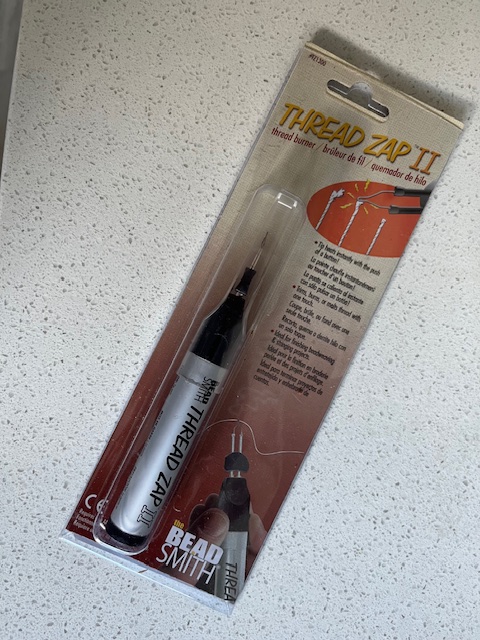
So try one of these ‘thread zappers’ in the photo above. I don’t know what kind of handicraft uses these. It’s basically a battery powered hot knife on a small scale. You just place the hot tip on the thread/s close up to the waste side of the knot. Press the button and it melts the cord off with an immaculate finish.

Very cheap on Amazon. I carry one in my toolbox all the time now.