Quite possibly you have tried Livestream style video coverage at your Club. We all enjoyed Gladstone, Croatia and several North American championships on YouTube. It’s early days but probably we’re all going to have to learn how to do it.
At the Datchet Worlds it was hugely important for us to get it right. Worldwide expectations were extremely high but more importantly the Press Coverage (Y&Y and Livestream by Evergreen) took up one third of the Championship budget. It was hugely important that it was “good”.
We took some risks, but how do you think it went? Nigel was keen to step up to the commentary role and spent six whole long days trying hard to make the video engaging to the wide audience. Immensely hard to do. He did brilliantly.
Nigel was of course getting loads of advice from all us experts everywhere – poor chap!! We’re all experts in watching sailing videos. Key advice though was to engage a larger audience by using skipper names, not simply sail numbers. Easy to say – hard to do when there’s 84 of them.
How??
Did you see how Nigel was doing it? Check any of the race videos and you’ll see that Nigel was constantly referring to a phone device in his left hand – scrolling with his left thumb – to get the skipper name (and result) information he needed.
If you click on this link using your phone, you will see what Nigel was seeing
Initially it was just to get Nigel (and Mark Jardine) the names and sail numbers to hand, but it was quickly obvious we could get them smack up to date results for each skipper too. How? We sent it from the Parallel Scoring systems. It was using a yet unannounced product called AFleet-Connect based on web servers in the US.
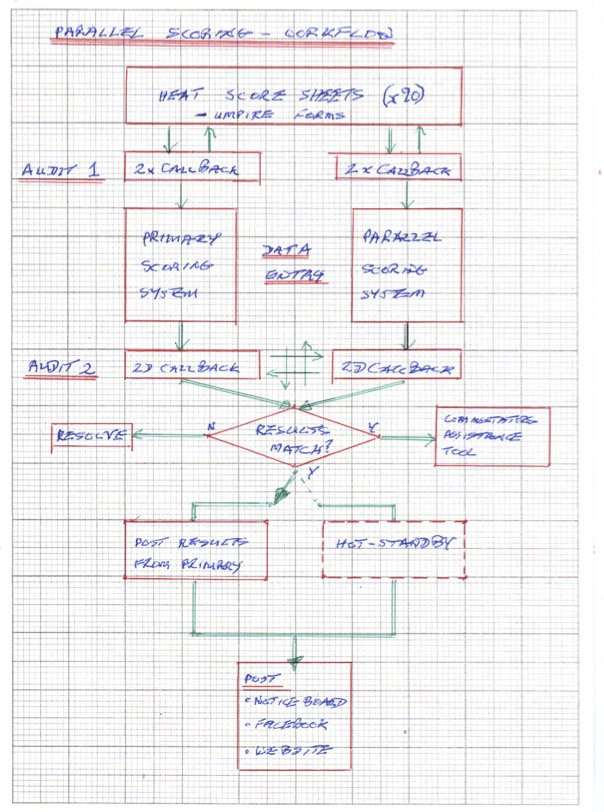
If you look through our workflow chart, after “Results Match?” you will see a box to the right in the Afleet column saying “Commentators Assistance Tool”.
That’s how we published it right there.
I was initially concerned after an incident at the Nationals with unapproved results getting out, that we might have a similar issue. You need one source of the truth in Results Publishing. But in the end, it was our brilliant new Parallel Scoring audit process that made it safe to issue. Absolutely every race completion saw us check every detail across HMS Excel and AFleet. It was only if we had precisely a 100% match, that I gave approval to the Team to release results. They went to the Official sources and Nigel/Mark’s handsets at the same time and the handset results were 100% identical to the HMS Results.
In the odd way of things, because the technology was so easy – we released the Commentators’ results from a tablet in New Zealand (our GlobalTeam!) and they reached the Commentary Team before the Scorers would have got their pins in the Clubhouse noticeboard …or before Austin popped the race results on to the website.
Update :
We have just deployed the same AFleet Connect technology at the DF65 Nationals at Barton’s Point. There the same feature was used to send results automatically (without webmaster intervention) to the East Kent Club website. Quite a few result updates were ‘sent’ from my kitchen many miles away !!!
In HMS based heat racing, you need to plan and expect around 3 heats an hour, lets say 20 minutes a heat.
Everything you do for a heat needs to fit into that 20 minute window. Wen we started trying to Parallel Score, it was surprising to find that everything could fit into what anyway seemed a busy 20 minute window,
When Parallel Scoring on your own, the first secret is to choose a Parallel Scoring system where the work basically happens at a different part of the 20 minute cycle. If I’m on my own, I enter scores into AFleet at the line looking over the Line Judges shoulders. I love it actually. Let’s say that happens in the first 2-3 minutes of the 20 minute cycle. You can’t basically get going with HMS Excel until the Baord Manager or Line Judge hands you the score sheet around minute 4. Entering a large heat carefully into HMS Excel takes only maybe three to four minutes. The rest of your time is spent with backups, publishing results and “issue management” plus queries.
What happens at a larger championship where you have more than one person to help. Check out our heat scoring workflow diagram above from the Worlds. Once you have more than one person you can immediately start to tackle the key objective of ERROR FREE RESULTS.
This concept of AUDITS in teams-driven parallel scoring is HUGE.
At the Worlds our scoring process was built around two big audits for each race cycle. A Worlds is high volume, believe me. One audit (top of the diagram) happens every heat, Audit 2 happens at the end of each race. Heat sheets will be handed over by the Line Judge/Board manager, and if you’re lucky, Umpire decision paperwork arrives at the same time.
Our process at the top of the chart, Data Entry, was that a QA Scorer would interpret and call the results from the sheet – and one scorer on each of HMS and Afleet enter the results as they are called. Then the scorer on the HMS Primary system would call the sail numbers back to the QA Scorer and the AFleet scorer to check everyone was in agreement and correct. It’s interesting the numbers of things you pick up – even when you think you’ve been careful.
The big focus is to keep errors from ever entering the system in the first place. Trap them at data entry. I’d say that 1-2 errors per day were caught this way at the worlds. It’s a very human process – so you get handwriting legibility, keying errors (nerves, workload, rain etc) and you certainly get umpire judgements that need triple checking and discussing. Stop errors getting in.
Do your backups heat by heat. Honestly it’s a big piece of work. It takes longer than entering results. JFDI and don’t miss a heat. We used the Andrew Crocker Fleetboard method for our backups and will describe that in another article.
If you are dealing with low order heats simply go back and do the next one as it arrives. 20 minutes flies by as there are always “issues” that need handling – if only hydration or lunch!
If you have just entered results for an A-heat, there is more audit work to do. Our process was to get the QA and Data Entry scorers assembled and check output two ways. The number one objective is to not let results containing an error out of the room. The HMS Primary scorer would print the results ready to go, then do two sets of calls to the other team members:-
1/ Call down the total computed scores column
2/ Call down the position column by sail number
If you can think of something better, let me know. But calling that set of 168 numbers takes around 3-4 minutes. They are some of the best 3-4 minutes you can use.
Honestly when doing it, you get desperate to reach the end of the two calls and everyone says “I agree”. If that doesn’t happen, it’s an emergency clinic session to find the problem and fix it.
Only when the HMS Primary Scorer and QA Caller says the results are good to go, does publication to the Official Notice Board, Facebook and Website happen.
Every time we officially released results we knew that both scoring systems were completely aligned and error free up to the completion of that heat. How often can we normally claim that? Those results were 100% correct. Every time.
Go read the flowchart above and contact us via this website if you have questions….
Autopsy:-
Well, you should be thinking…. “If you’re using one scoring system and not parallel scoring, what happens normally??”
You know, I’ve been worried about that too.
I suspect as a matter of course, it’s not uncommon that Regatta results come out with little winkles buried in them. I’ve heard it said, “the answer to your question is whatever the system says…”
So I think we ‘usually’ see regattas with imbedded errors. We must do.
If the Scorer detects an error though, instead of cursing we should celebrate. In this high volume data, human driven environment there will be errors. Just find them. It’s good.
At the IOM Nationals, our error checking was only half as good as we did at the Worlds. We had around 1000 Nationals boat results in each of the systems and actually our audits successfully picked up two errors… in a thousand results. One on each of HMS Excel and Afleet as it turned out. I dont think anyone would have noticed, but the point is that we found them and sorted it. Two errors per thousand boat results. Celebrate finding them.
But at the Worlds, no results sheets left the scorers office until they were clean. Honestly. Those results were perfect. Every time.
I was interested as to what the formal Worlds process was for an aggrieved competitor to query their score. Honestly it was a very protesty environment …. I thought scoring queries were inevitable. I hadn’t seen it before but the Umpires had a formal “Scoring Enquiry Sheet” that a competitor with a scoring grievance had to fill in to send to the Scorers.
During 90 heats of the IOM Worlds, we received precisely zero Scoring Enquiry Sheets.
Although we felt emotionally that the final 2-way audit before publishing was the big leap forward, I’ve had time to reflect. In retrospect, the challenge is to prevent errors ever getting in to the systems in the first place. Audit 1 in the diagram above is probably the key. Together as a Team – Check Umpire decision completion very carefully, review handwriting squiggles, boats in the wrong heat (if any) and get that data extremely clean before entering it in your systems.
It can still be wrong – I feel badly now that the Nationals Race Committee handed the Scorers a verbal Redress Decision for boat 95 (!!). I know now that the Race Committee was wrong and as Scorers we should not have let the error in. It is actually OK to tell the Race Committee they were wrong too – it simply takes courage!! I must apologise to Graham when I next see him 🙂
So – fully audited results cross checked across two systems… is this a world first in radio sailing?
At your Club, are you heading towards hosting a large Championship soon?
Obviously when you’re headed towards hosting a Worlds as we were, you start thinking about the BIG questions a year or two ahead. You’ll know already that Datchet tried to always have at least two ways to do any single job at the Worlds. Does this approach apply to Scoring?? … Hell, YES !
What are the really big questions to consider in Scoring? Well, for a start you have 84 people about to arrive who have spent a lot of money to come and race with you for a week. At the end of the week, or at the end of the Championship, regardless of the week they had, they ALL want to see their name on that Results Listing.
Yes – On that last day, 84 “experts” will all gaze at the beautiful printout that you have pinned to the Official Notice Board. They expect two things –
it’ll look smart and professional and their name was correctly spelled
It will have precisely ZERO errors on it. If they find an error at that point, especially in their own score, your name will be MUD. The subject of clean results, as it happens, is a whole new thing if you Parallel Score.
Reputation Protection – The Big Issue:-
Selfishly, for your Club you should be thinking of protecting the Club’s Reputation. It takes years to build up a reputation to be considered anywhere near “capable”. As we all know from 2025, you can destroy Club reputation in a flash. Reputation takes years to build and just minutes to destroy. If Scoring were the perceived failure point, it’ll take less than a few minutes to destroy. It’ll be talked about (with sniggers) in Club bars across the world for years.
Within Scoring, everyone will tell you “it’ll never go wrong”. …. “one in a thousand chance…” etc.
Don’t you believe it. What would you do to protect your Club Reputation?
In considering Parallel Scoring, we would consider it :-
for a 30 Boat Event? …. Probably, No
For a 45-55 Boat event? … Well maybe
For a 55-84 boat event?… Yes, for sure.
A simple way to think about it? If the scorer or scoring system fell over on the Penultimate Day, could the Championship recover by some other means – even paper scoring?? If you have already entered a couple of thousand boat results, just think what it means.
In 2024, we made the decision to score our various upcoming Championships into two separate scoring systems at once. We called the technique, “Parallel Scoring”.
Not simply having hot standby laptops and USB sticks…. but two systems at once.
Does this mean double the work? NO.
Are there surprising benefits? YES!!
Which two scoring systems? Everyone wants to know. Regardless of if you’re racing to HMS Rules or SHRS Rules, you should first think of what volunteer skills and platforms you can access locally. Start there.
At our Club we had people with knowledge of three scoring systems for heat based racing – the MYA’s HMS Excel, HMS on AFleet and HMS on Andrew Crocker’s brilliant Fleetboard. These are three really good scoring systems. We were spoilt for choice. We shall write more on the website later about why we chose what did …and probably it will not be for the reasons you expect. …Start with the volunteers you can get and the scoring skills that they have.
Consider the technology skills you might need too – I was keen to have a team member who is a Microsoft Professional for a living. How fantastic that turned out to be.
When you choose both your scoring systems, remember that if the two systems do not run on entirely separate technologies…. there is really no point.
When you later read our analysis of the things that can/did go wrong, you’ll fully appreciate the depth of the issue and separate tech.
We felt it natural to choose HMS Excel as our primary system and then Afleet as our Parallel System.
We decided with the PRO that unless we had a catastrophic situation, official results would simply always be from our primary platform – HMS Excel 2022.


 Datchet Radio Sailing - Making It All Much Easier !!