
Last weekend was the third in a row where we have had a member’s boat drop radio signal while racing. First up was Hugh’s F6 – turned out to be battery, then my IOM – turned out to be the on-off switch, then last Sunday it was Jim’s turn in his F6. Not sure of the cause just yet….
It’s pretty natural when the transmitter loses the boat that our first reaction is to stare at the transmitter and growl loudly at it. The thing which you drive the boat with… using your highly skilled hands , just went dead on you, ….right there in your snug, and at a critical moment….. Natural reaction…. Grrrr
Have you considered it might NEVER be the transmitter’s fault?? These things after all are just solid state lumps of technology.
Phil has a great story of losing signal to the boat with a Futaba. Then he discovered that rotating the transmitter vertically, so that the aerial handle was vertical, caused the boat to reconnect and take off again. Interesting, but the weak link might still be at the boat end of things, ands not the transmitter in one’s hands.
Well probably not “NEVER”…. However, chat around our club members in the clubhouse and everyone has a horror story about every single transmitter brand, and it usually ends up “I had to throw my Spektrum/Futaba/Radiomaster/Flysky away….” (delete as appropriate)
So I came to thinking it might never be the solid state (not much variability) transmitter kit we all know and love. It might be the other end of the signal – the receiver in the boat that is the most common cause. We all spend a tad less care, money and attention on that.
There are a couple of very topical “antenna-less” receivers used at our club. First off is the Spektrum AR620 which is praised highly by Rohan and Craig (who gets five votes anyway!). No dangly wires causing variability according to way the way you chuck them in. The little built in antenna is designed by Texas Instruments. They say it gives better range than …. well, better than what? Better than their wired antennas, but we have no measure of them, do we??
Phil uses a similarly stunning wire-free ELRS antenna on his Radiomaster setup. Very strong performance I’d say. No drops yet. These wire-free antennas are about the size of a sugar cube, so it’s mind boggling that they can have better reception than lengths of antenna wire, but listen to the video above about the AR620
It seems to me that the key point is that they are going to have minimal variability from one outing to the next. VERY solid state. If it works well, it’s going to work well every time out.
By the way, next time you hear a “I had to throw it away” story, try and remember to ask if the boat hull was carbon fibre or fibreglass. Honestly – if you google “carbon fibre radio reception” you get simply hundreds of articles basically saying that carbon fibre near your antenna is never going to improve signal. It will quite probably weaken it – though not block it entirely. Would we know??…
I’ve a sailsetc type plastic pot for the receiver in my carbon F6 and I think I’ll do the same in the next F6.
So – we have wire-free good sounding receivers in Radiomaster and Spektrum. Futaba don’t sell one yet, and if you have a futaba you will be on dangly wire receivers.
If you are male and married, do you get this thing at home from the Steering Committee about women always read instructions and men never do?? … I know, I know…. me too.
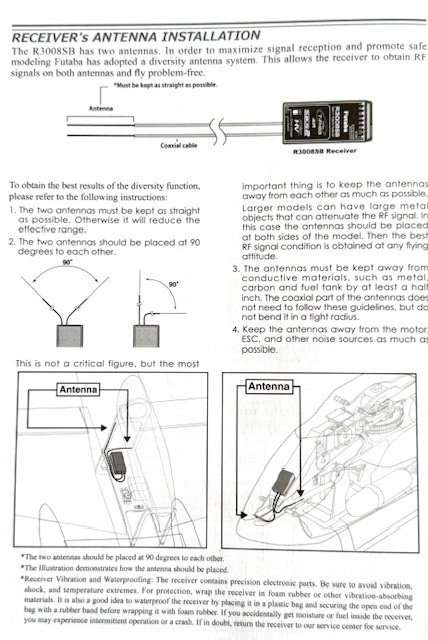
This is the Futaba manual page about wiring their receiver antennae. I’d swear I knew all that, but when I just checked the F6…. well maybe I was not quite as thorough as I thought I’d been.
First up, we will all have fellow competitors who just bung the wires in the pot and get on with it. “Makes no difference”, (sounds like me) but actually maybe we never really sail much near the edge of range. I’m a bit like that, with a slight tendency to buy a gadget to cope with it – in my case a Sailsetc antenna frame – but as you will see, I still got it wrong.

The futaba manual is very clear that the antenna is mainly covered by a coaxial sheath ( I thought it was just a plastic sleeve). Only 1-2″ of bare antenna is exposed – and it’s those bare tails that are best fitted at 90degrees to each other. Both their examples in the manual also show that the antenna tips are ending up far apart. With the Sailsetc frame, you can thread the wires so that the tips come together, OR are far apart…. I confess, I thought the wire was in a protective sheath and just exposed at the ends. So I popped the whole sheathed antenna through the 90 degree Sailsetc frame….. WRONG, and NAUGHTY BOY!! The manual is very clear – only the exposed tails should be at 90 degrees.
You will also see that my antenna on a 3008SB receiver, first have a coaxial sheath, then have a rubber seal (not shown in the manual) and then only about 7mm of exposed wire. So I assume the rubberised length of about 50mm WILL receive signal.
I have rethreaded it and it now looks like this….

I’ll only know if it’s effective if nothing ever happens….
 Datchet Radio Sailing - Making It All Much Easier !!