
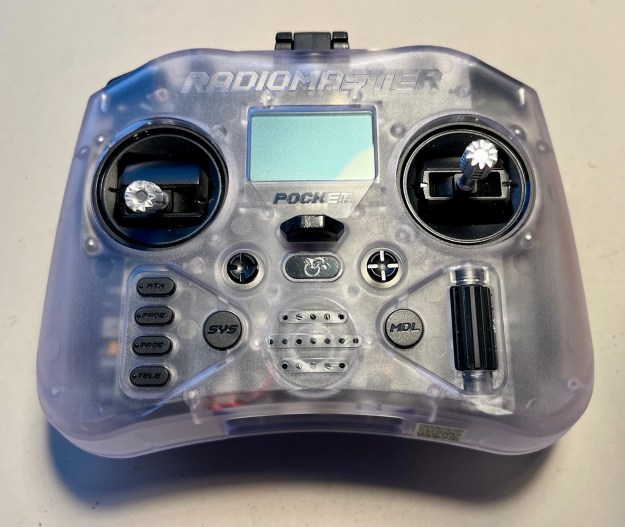
So maybe you’ve just bought your first boat only to find you need to separately find yourself a transmitter? Or you just will get a new one?
The first thing you find when you google it, is that there are lots out there. On many occasions, you’ll land on a website only to discover that the seller splits the transmitters into “Air” or “Surface”. …. Baffling.
Before the modern wave of 2.4ghz radios it seems that it was thought better to help prevent signals on radio control race cars accidentally being picked up by a radio controlled plane overhead – and crashing them to the ground. So it was prudent to split frequencies – or at least I think that was the idea. To this day, you will see that MYA Entry Forms still ask for wavelength, a legacy of those days I guess – and we all fill in “2.4ghz”. Our radios all pair precisely to the receivers in our boats – no problems.
A manufacturer legacy of those days is still to classify their transmitters as either Air or Surface. You see that on seller websites a lot. Now before you immediately go and look at “Surface transmitters” as we sail on the surface…. Stop!! You want to look at “Air Transmitters”. We use airplane type transmitters for sailing.
It looks like “Surface” designs now tend to be pistol grips (rc cars?) and “Air” designs have the twin joysticks that radio sailors use.
So : You want to look for “Air” and “Mode 2”, the latter being about the way the joysticks are arranged. Mode 2 is rudder on the right. That’s what we use.
You might also come across the term “Open TX”. For now, just ignore this. This is the transmitter manufacturer equivalent of linux in the home computer world – free shared industry software for driving the transmitter as opposed to manufacturer proprietary software. There are pluses and minuses – and you’ll be wondering about those as you read. It should in theory make it all cheaper in the long run. At the present, Radiomaster, FrSky, Jumper and one or two others have adopted OpenTX.
 Datchet Radio Sailing - Making It All Much Easier !!