Rig Tension – What Does That Mean in Radio Sailing?

When we all decide to come to radio sailing, one of the first things that grabs our onshore attention is people staring down masts with their knowing one-eyed look, tweaking stays with their sturdy race tuned fingers … and making clever approving noises. It’s great !
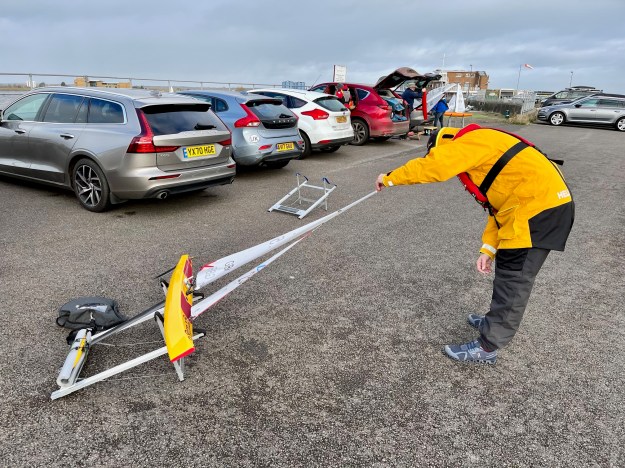
The curve of the mast is an interesting topic in itself. If you search Youtube for IOM videos you’ll hear experts looking for anything between “dead straight mast” to “a bit of prebend”.

Baffling, but fear not!!

On Nigel Barrow’s excellent website, he recommends a rig tension gauge by John Gill. It looks like this…

The sharp-eyed amongst you will notice John’s email address on the gauge if you want to contact him to get one. It’s a lovely carbon fibre thing – I just love it. Anyway, as Nigel points out, if you want to demystify your rig, get one of these.

If you are a keelboat sailor in your past, you’ll immediately recognise the basic idea. If you’ve had a Loos Gauge in your history, it is basically the same idea. I raced `Flying Fifteens for 25 years – the Loos Gauge is the central calibration measure for everything. I never went anywhere without mine. Honestly.

See those two big screws at the top of the gauge? You slide your shroud wire between those two (they stand proud) and the gauge gives you a way to understand rig tension versus deflection. Then you look up the gauge reading on a little chart, and if you know your wire diameter then you can read your tension in kgs.
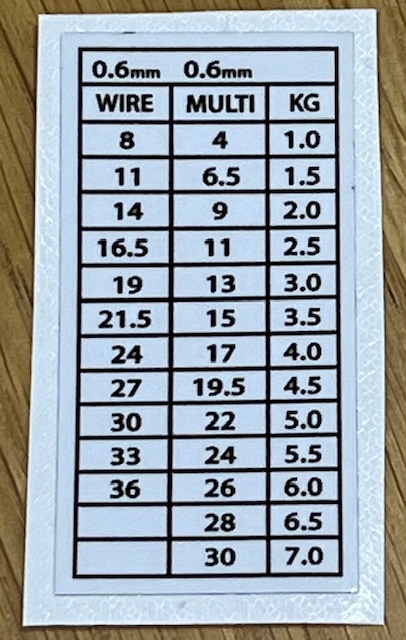
We used to do the same in Flying Fifteens, but I soon lost the appetite to know tension in kgs … all you need to know is what the damn gauge number is.

©John Gill

If you look at John Gill’s photos above, you’ll see the way to use the gauge. (a bit blurred, sorry)

As Nigel Barrow points out, it’s quite a revelation to know precisely if your IOM shrouds are carrying the same tension, or you pop a new replacement shroud in and you want to get the tension matched again. Very good.

In 2024 I set myself two other goals:-

  • I want to get a feeling of also what backstay tension readouts correspond with apparently good performance
  • Now what about Marbleheads? No shrouds…. But actually rig tension is a very black art in the Marblehead, and there must be a way to shine some light into my darkness. I want to write separately about measuring jib swivel tension on a Marblehead – but give me time.

Calibrate, calibrate, repeat, repeat…. my New Year Resolution for 2024

Do You Get Cold When Racing at This Time of Year?

Do you find it a bit nippy in the colder months, striding up and down the foreshore?? Hanging around for start sequences?? Especially on the breezy days?

I must admit, in my first winter IOM series, it got seriously cold, and I got seriously cold… then the enjoyment declined. The way to deal with this was shown to me by a great friend at Chipstead RSC. … A battery heated gilet….

I was incredulous at first… but, honestly, it was a total revelation. Amazing. For a start, the battery lasts about four hours, so you get protection for just the right amount of time to cover a radio sailing session.

Although I call it a gilet, you wear it under your top layers, so you want to read all the customer reviews about garment sizing (important). I wear mine on top of a cotton T-shirt, but under everything else.

If you look on Amazon there are simply loads of designs to choose from. They all seem to have heated panels in different places and I especially wanted heated lower back panels. You just choose which suits you best. I think on mine, additionally the user can also select back/front/both for heating zones… and high/medium/low heat as well. Great!

The second revelation was the price. On Amazon it was about £50. Ridiculous! The rechargeable (on USB cable) battery, which is about the size of an iPhone, costs £20 extra. You just pop it in a pocket inside the gilet.

Blimey that’s less than a set of thermals from Musto or Rooster. I’m in the second winter now and it’s still working! I’m wondering about adding a second battery for longer days.

LT at Datchet is also trialling one this winter. Results are good, I believe. I’m surprised that RW (our “Mr Style”) hasn’t got one yet.

Great Christmas present and you get more races in!

These products come and go on Amazon, but this was the search term I used….

Vapesoon Heated Vest Heating Jacket with 3 Adjustable Temperature Electric USB Rechargeable Winter Thermal Vest Warm for Outdoor Camping Riding Hiking (Battery Pack Not Included)

Winter Racing? Got Cold Fingers??

Racing your boat through the winter? Great !!

I’ve always enjoyed racing through the year plus you get your money’s worth from the membership fee – ha!! Basically at Datchet, our formal scored series run February to November, but if you fancy racing with someone in December and January you can just turn up. Use the WhatsApp group to find someone to race with!

I do find though that the fingers can get cold on those little joysticks! I know the transmitter covers are called “snugs”, but honestly there’s snug and … SNUG !!

The first gloves I tried were quickly discarded. I found the leather was too thick to let you feel the joysticks properly. So now I’m on my second pair of Cycling Glove Liners.

The first part I bought were beautiful merino wool gloves. However, I found holes in the finger tips very quickly.

Now I am using glove liners made of 80% polyester and 20% elastane. Finger tip feel is simply perfect, they fit like a second skin – and they don’t seem to wear into holes. Very warm inside the transmitter snug.

If you go on to cycling clothing websites like Wiggle, you will find loads to choose from and they are miles cheaper than Merino wool.

Christmas present?