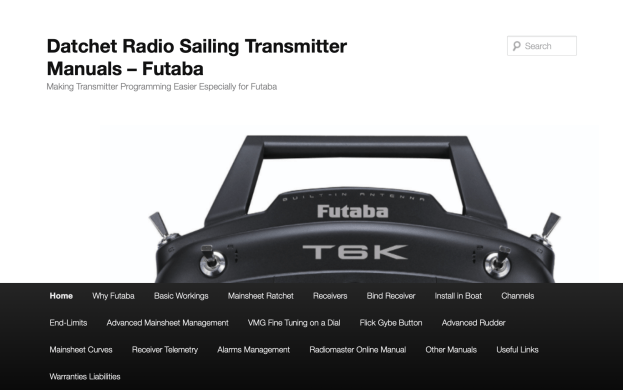
When we launched the Datchet Radio Sailing website in late 2023, we had an eye on trying to reduce the inhibitors people often feel when they get into radio sailing.
A few “Beginners Guide” manuals were created as downloads, mainly for radio transmitters, but also the likes of installing new winches (very popular!), diagnosing problems in the electrics, installing new transmitters and so on.
The response has been amazing. In a few days time, the radio transmitter global downloads of the manuals are going to reach a total of 1000. It’s 985 downloads as I type (August 2025). Of those, about half are for the Radiomaster – interesting.
The beginners guide on how to fit a new winch has, alone, been downloaded 255 times. How to install a new transmitter has been downloaded 72 times.
The Futaba and Flysky manuals are about equally popular as each other – Futuaba slightly more so.
I have a Spektrum in the workshop ready to install on a Proteus IOM. I had a plan to produce a manual for that also (one day … takes a lot of time). In the meantime, there is a link to an excellent radio sailing manual for the Spektrum DX6 on a US based website. If anyone wants to give a hand with that, don’t hesitate to get in touch.
I managed to get my hands on one of these a couple of days ago. From the airplane and gliding world, the FrSky Tandem X20….. Bit of a wow. It was interesting to see what they use over in flying.
They cost about double (450GBPs) what radio sailors would think of as “pricey”, but can you tell the difference?
Amazingly – a resounding “yes”…. the feel was a huge step up from what we are used to. The body was a lot more solid (alloy maybe) and interestingly weighed about 900g so a bit heavier than common radio sailing transmitters. It felt very good in my size/shape hands. The “Apple” of transmitters maybe.
Gimballs (“Hall gimbals”) very smooth and more central on the console which somehow gave a nice balance (nearer centre of gravity perhaps) while you used it. Thinking about it more, if you move the screen to the top of the unit (most of our transmitters have the screen at the bottom), you can then move the gimbals down lower on the console itself.
Another thing I noticed was that the gimbals can be rotated slightly for those in search of more comfort over longer periods. Somehow, the whole thing looked more showerproof too. Really tightly fitted together.
When we decided to write the radio sailing manual for Radiomaster transmitters, I came across FrSky because the previous range FrSky along with Radiomaster use the same OpenTX software. FrSky seem to have abandoned that OpenTX strategy now as it was holding them back. They have done their own modern looking operating software called EthOS. That’s amazing too – it’s like having a full iPhone aboard, …all icons, colour and sexiness. Lots of preloaded configurations for power mixing and the like.
I might have misunderstood, but the owner said you could send updates (like custom model configurations) to it “over the air”…. so he can swap configurations with friends very easily.
The owner of the unit that I tried was a Competition Gliding fan. I asked what he used previously, and interestingly he had a Spektrum DX6E – which of course is very common in sailing.
Way over-configured for the needs of radiosailing, but it was interesting to see what £450 would buy you.
Do you think radio control aircraft flyers ever get cold hands?? I’m beginning to wonder…
Maybe they don’t!! Radio Sailors on the other hand usually do want some warm, dry, hand protection and it’s extremely usual for us to use “Transmitter snugs” to keep our fingers warm !!
Our transmitters are generally model aircraft transmitters and we use a tiny proportion of their capability in Radio Sailing. Not all of them come with switches for aircraft pilots to play with, but the more you pay the more switches you will see on there. Lets be clear – far fewer radio sailors use ANY of the switches, but if you find yourself tempted quite possibly your transmitter is festooned with the them..
By “switches”, I am referring to those little silver spikey things such as the ones you can see in the photos above. If you are tempted to try one of these switches for sailing, then read-on.
In way of a suggestion, consider whether when inside a “transmitter snug” the switches can get inadvertently flicked/activated by the very material that is keeping your hands warm. Certainly when you take your hands out of the snug and perhaps place the transmitter to one side, you are open to this happening.
It won’t happen on the Radiomaster Pocket (switches safely recessed) but Flysky, Spektrum and the Futabas generally have them running along facing you on what I think of as “the top” …. meaning the console where the joysticks are located. Futaba and Spektrum also have switches on the back panel, slightly hidden away from you. To make it more interesting there are often two different switch arm lengths. What I have been finding is that the longer switch arms (lovely action!!) are the ones that can snag on the inside of the transmitter snug. When it happens, it’s quite difficult to spot until something doesn’t work on the boat as you expect…. usually at a crucial moment!!
The Flysky I tried at the weekend additionally needed those switches all in the off position just to power up successfully. The Flysky only has switches along “the top” if I recall correctly. (see photo above)
So my suggestions if you really, really want to try switches would be :-
1/ Choose the short stubby switches if you can, as they are often “protected” against snagging by a tall switch located next to them.
2/ Consider only using short stubby switches on the back panel if it fits your way of thinking. A reduced chance of snagging back there….
3/ If you get cross, don’t throw away that transmitter snug!!