Category Archives: Radio Equipment

Living in The Southeast? Do You know TJD Models…?

It probably doesn’t matter if you live in the Southeast of UK or not…. but we are all interested in where we can find shops and suppliers useful to radio sailors.

When I borrowed an IOM to start radio sailing, I needed some help to replace batteries with JST connectors and also intelligent chargers. A Chipstead member recommended TJD Models at a little place in North West Kent named Sutton at Hone. Maybe all model shops are like theirs, but to me the range of stock seemed enormous.

They were all about rc cars and planes, but listened patiently to me wittering on about radio sailing. They were really helpful and to meet my requirement, they had to pop out the back and solder up some connectors for me free of charge. Really kind and helpful. Nothing was too much trouble. I promised them straight away that I’d be back.

For one reason and another it was a few months before I thought to contact them. I decided I’d get a spare radio receiver to keep in my toolbox.

I placed the order on their website at 4.58pm on a Saturday. I was thinking delivery maybe the following Wednesday. Honestly,…. at 5.45pm the same afternoon there was a ring on the doorbell and a smart guy hands me a package and says “here’s your receiver”…. I couldn’t believe it. 47 minutes delivery.

Basically I had only just logged off from the computer. I couldn’t figure momentarily what had just happened. It was like I had a “Dr Who Tardis” type moment. Time warp in action. The super kind chap from TJD had dropped the package off on his way home.

Beat that, Amazon Prime…..Or Deliveroo.
https://www.tjdmodels.com

Radio Receiver Chatter – Interesting Short Video….!

I saw in the Club WhatsApp group some exchanges about transmitters and receivers. In particular, Craig and Rohan were very keen on a receiver unit called the AR620 from Spektrum.

This little video came up when I googled it. It’s just a few minutes long. It’s an interview with the Technical Director of Spektrum. It is pretty interesting to hear what the product designers think is important. Of course, it’s 100% about planes and rc cars, but nonetheless I was intrigued to hear his comments about:-

  • No antenna – integrated aerial by Texas Instruments and it actually performs better than dangly wire aerials
  • Binding to the transmitter via a button, and two methods
  • FlyBy telemetry for reading onboard battery capacity, and “flyby” means it only works to a range of 600-800 feet
  • A very intriguing set of remarks about mounting the receiver 2-3 inches away from carbon fibre in the plane fuselage as the carbon blocks the signal. Given the amount of carbon fibre in our Marbleheads, it’s worth reflecting over. Note that Craig and Rohan didn’t make any comments about this being a problem. A small (not thorough) piece of research from me said that Kevlar does let radio signals in. Interesting.
  • Quite a large amount of chat about two failsafe modes, “PreSet” and “SmartSafe” and the “Hold Last Command”. In radio sailing that part of worth listening to a couple of times.

Transmitters for Beginners 2 – Are We “Air” or “Surface”? (Trick Question)

So maybe you’ve just bought your first boat only to find you need to separately find yourself a transmitter? Or you just will get a new one?

The first thing you find when you google it, is that there are lots out there. On many occasions, you’ll land on a website only to discover that the seller splits the transmitters into “Air” or “Surface”. …. Baffling.

Before the modern wave of 2.4ghz radios it seems that it was thought better to help prevent signals on radio control race cars accidentally being picked up by a radio controlled plane overhead – and crashing them to the ground. So it was prudent to split frequencies – or at least I think that was the idea. To this day, you will see that MYA Entry Forms still ask for wavelength, a legacy of those days I guess – and we all fill in “2.4ghz”. Our radios all pair precisely to the receivers in our boats – no problems.

A manufacturer legacy of those days is still to classify their transmitters as either Air or Surface. You see that on seller websites a lot. Now before you immediately go and look at “Surface transmitters” as we sail on the surface…. Stop!! You want to look at “Air Transmitters”. We use airplane type transmitters for sailing.

It looks like “Surface” designs now tend to be pistol grips (rc cars?) and “Air” designs have the twin joysticks that radio sailors use.

So : You want to look for “Air” and “Mode 2”, the latter being about the way the joysticks are arranged. Mode 2 is rudder on the right. That’s what we use.

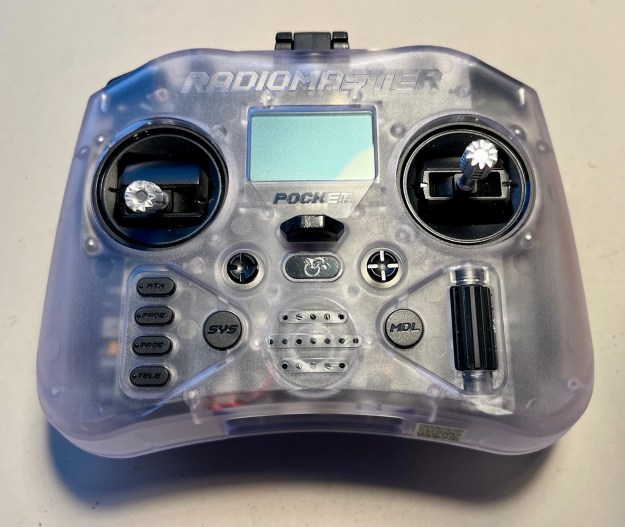
You might also come across the term “Open TX”. For now, just ignore this. This is the transmitter manufacturer equivalent of linux in the home computer world – free shared industry software for driving the transmitter as opposed to manufacturer proprietary software. There are pluses and minuses – and you’ll be wondering about those as you read. It should in theory make it all cheaper in the long run. At the present, Radiomaster, FrSky, Jumper and one or two others have adopted OpenTX.

http://www.open-tx.org/radios