We have written in another website article where to source computer cut vinyl hull numbers. (I used “Vinyl Letters Ltd”).
There’s a trick to putting them on. See below.
For the IOM, and I think all the international classes, the minimum height allowed is 20mm. The numbers arrive on a strip about 25mmx80mm, nicely spaced and so on – which for our application is irrelevant. They were only about £2.50 a strip, so I ordered two strips, assuming I would wreck at least one number.
Honestly, I didn’t think the four digits would fit around the curve. I cut the strip into individual numbers and worked it that way.
Now you know the “hack”, do you?? Wet the surface first, before applying the letters, with a mild soapy solution – water and dishwashing liquid. You don’t want neat fairy liquid, but when you smear it on the surface if to the naked eye it runs off, then it’s too weak. Add a few more drops of soap to the mix and try again. Eventually your smear will stay on the surface.
Then one character at a time, sticky side down, you’ll find you can attach them and slide them around to get them in the desired place. Then just leave them to dry out. Hopefully you’ll find them 100% stuck on.
One sunny day racing at Chipstead, I noticed a lovely competitor measuring his mainsail twist with one hand using a battered bit of cardboard with two pen marks on it. Much easier than twelve inch steel rules and tapes.
“What gap are you looking for?”, I innocently asked. “Secret…”, came the reply!!!
Nine months after taking the plunge, my new K2 IOM arrived. It also has a full tuning and trimming guide with it. The main matrix page has literally 84 numbers on it….. that’s about 80 too many for the beginner!!
So what to do?? I remembered the piece of cardboard from Chipstead.
It is fashionable it seems that every row of a tuning matrix has settings for waves, and settings for flat water. If you set out to make a trimming tool, you can choose “flat” or “waves” or combination and knock 42 numbers out of the matrix straight away.
In the RedAnt Tuning matrix for the F6 Marblehead, I reckon that at the centre of thinking there are four numbers…. at the heart of rig set-up.
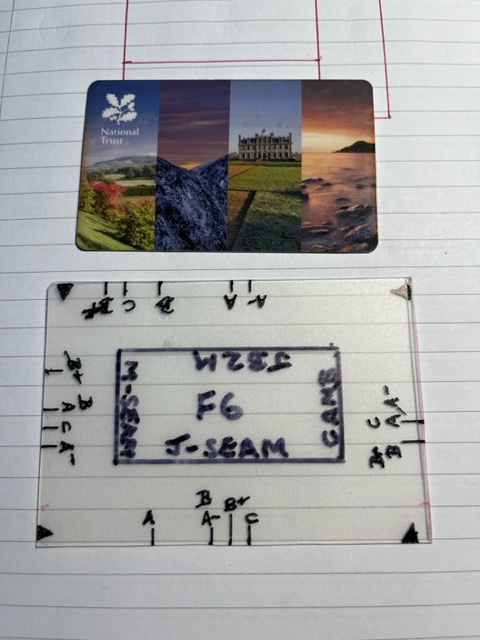
Now look at the photo above. I am using four sides of a kind of pocket ruler (100mmx60mm) to give me an F6 trimming tool. I have started by placing five rig settings on there – A with A- (both flat water) and B, B+ and C (all for waves).
After a quick fiddle in the garage so far, I’m very encouraged. I accidentally cut the tool out of semi-translucent plastic, which I now realise it vital – you sometimes need view it from the back. I used the plastic from the front cover of one of those spiral bound A4 notebooks that you see in the stationers..
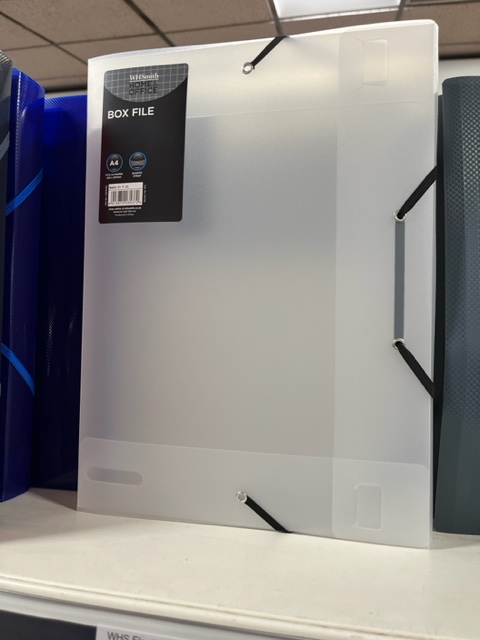
If you cant find a notebook with plastic covers (cheapest route) then I spotted this box file in WH Smith this morning – approximately the same material as I used.
So on that bit of plastic, I hope to have 20 key variables and on any day I would use four of them. The precise numbers aren’t shown … “secret”!!
I reckon it’s five variables, not four, for my K2, …so slightly challenging for a four sided plastic ruler concept, but I’ve found a way. I’ve made separate K2 tuning tools, one for the Sunday Club (waves common) and one for the Wednesday club (always flat water).
Will it move me from the back of the fleet up to the middle ?! I doubt it…. !!
However, I reckon when you start out you have to quickly get to learn “what looks right”. ,… And experimenting with the trimming tool in the garage it quickly gets you to what the builder and sailmaker think “looks right”. …It helps. So I feel the main point of the trimming tool is to shorten the time (measured in years!) it takes the beginner to learn “what looks right”….. Then I hope to be mid-fleet!
When you start radio sailing, quite quickly you notice the amount of attention that competitors pay to trimming and tuning their rigs.
Does it make a difference? Well, in our recent IOM meeting which was using six-leg courses, the leaders were finishing in around 12 minutes a whole leg in front of the competitors at the back. So setting God-like tactics, skill and good-looks to one side for the moment, superficially they are going about 15% faster. Amazing.
Confounding matters, the top competitors seem to do rig set-up by eye – no measuring rules or tape measures or anything. Sometimes you’ll see two or three fingers being thrust in a gap in the rigs. Baffling….. So where do you start??
I started radio sailing a little last year with a borrowed Britpop with BG sails. It’s a very popular combination. There is a public download on tuning and trimming from BG Sails.


 Datchet Radio Sailing - Making It All Much Easier !!