Category Archives: Boat Setup and Tuning

Rig Tension – What Does That Mean in Radio Sailing?

When we all decide to come to radio sailing, one of the first things that grabs our onshore attention is people staring down masts with their knowing one-eyed look, tweaking stays with their sturdy race tuned fingers … and making clever approving noises. It’s great !
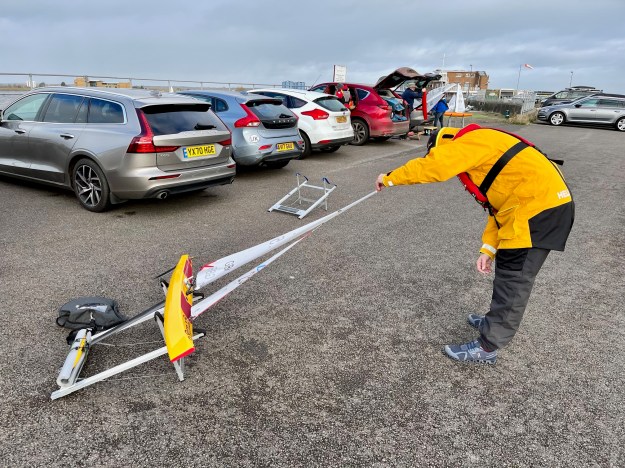
The curve of the mast is an interesting topic in itself. If you search Youtube for IOM videos you’ll hear experts looking for anything between “dead straight mast” to “a bit of prebend”.

Baffling, but fear not!!

On Nigel Barrow’s excellent website, he recommends a rig tension gauge by John Gill. It looks like this…

The sharp-eyed amongst you will notice John’s email address on the gauge if you want to contact him to get one. It’s a lovely carbon fibre thing – I just love it. Anyway, as Nigel points out, if you want to demystify your rig, get one of these.

If you are a keelboat sailor in your past, you’ll immediately recognise the basic idea. If you’ve had a Loos Gauge in your history, it is basically the same idea. I raced `Flying Fifteens for 25 years – the Loos Gauge is the central calibration measure for everything. I never went anywhere without mine. Honestly.

See those two big screws at the top of the gauge? You slide your shroud wire between those two (they stand proud) and the gauge gives you a way to understand rig tension versus deflection. Then you look up the gauge reading on a little chart, and if you know your wire diameter then you can read your tension in kgs.
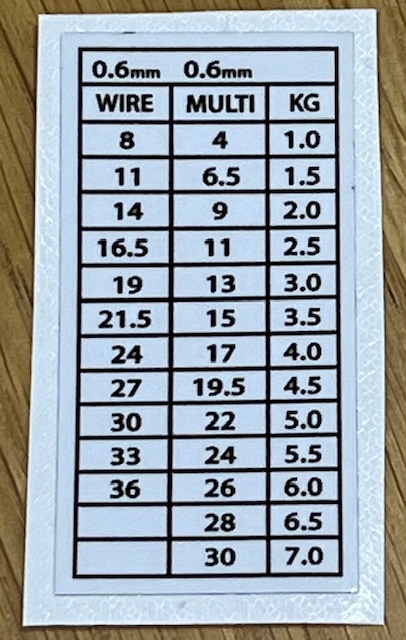
We used to do the same in Flying Fifteens, but I soon lost the appetite to know tension in kgs … all you need to know is what the damn gauge number is.

©John Gill

If you look at John Gill’s photos above, you’ll see the way to use the gauge. (a bit blurred, sorry)

As Nigel Barrow points out, it’s quite a revelation to know precisely if your IOM shrouds are carrying the same tension, or you pop a new replacement shroud in and you want to get the tension matched again. Very good.

In 2024 I set myself two other goals:-

  • I want to get a feeling of also what backstay tension readouts correspond with apparently good performance
  • Now what about Marbleheads? No shrouds…. But actually rig tension is a very black art in the Marblehead, and there must be a way to shine some light into my darkness. I want to write separately about measuring jib swivel tension on a Marblehead – but give me time.

Calibrate, calibrate, repeat, repeat…. my New Year Resolution for 2024
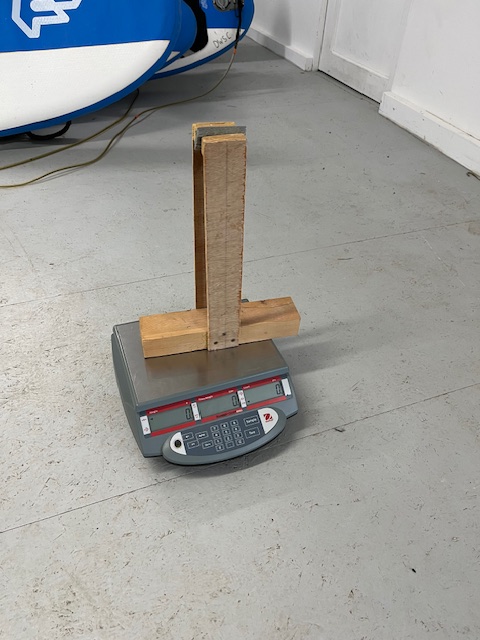
How They Weigh a One Metre ?

When you come into Radio Sailing, you hear a lot about weights. It’s a hot topic, just like it is in dinghy and keelboat racing.

As an aside : when I ordered a new Dragon keelboat, I remember going to the builder (who had lots of Olympic golds, world titles and the rest of it) and asking what weight he thought the boat would come out at. He said 1700kg is the rule. I naturally asked, “Yes, but what weight do you think you can build mine to?”… “1700kg” came the reply. And he did. Amazing.

So in at least One Metres and Marbleheads, owners and builders have the same keen interest in weights as my Dragon Builder.

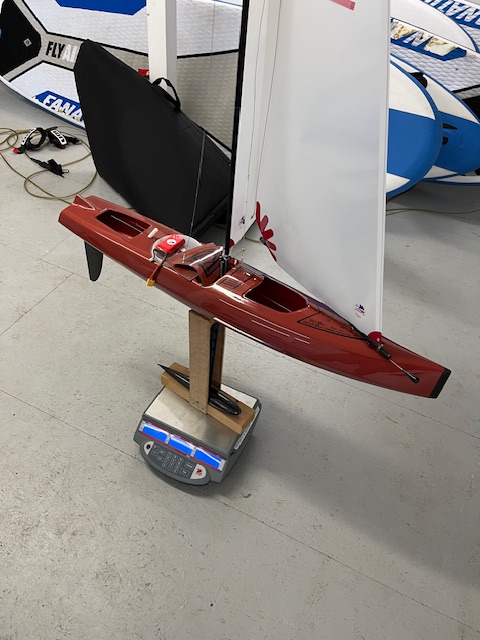
I was keen to see my new IOM weighed. The photo above shows the setup. A digital scale with fine graduations plus a wooden IOM standing bracket. Easy enough to see how the Measurer does his job now.

In fact, here is my boat being weighed. Note hatches and onboard battery are inside the weight limit.

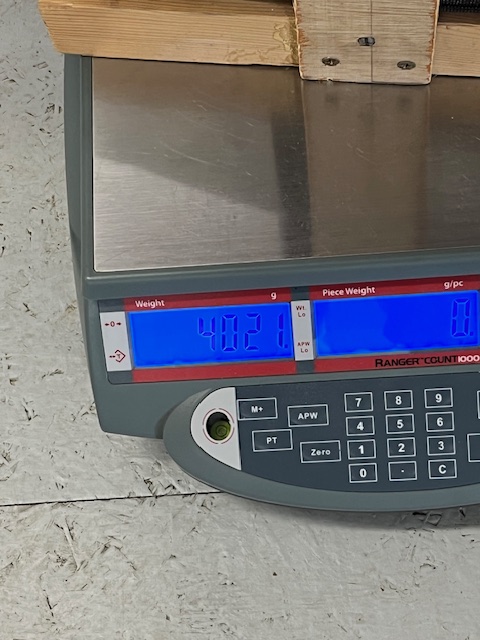
Thinking of my Dragon story above, I thought you’d be interested to see how accurate my IOM builder was. “He’s 21Gms over!”, you proclaim !!

Well, I thought that too, so I asked him. I take it that lots of people do. I received a well practiced answer. He says that they target 20gms over because they find that scales around championships do vary. So if you weigh in at a Championship and it looks like you are 20gms over, you can always pop the corrector out.

OK – so he was 1gram over !!….

“Antenna Frame” Anyone??

When I read up about my transmitter’s working range, of course it’s all about airplanes and drones. “1.5km range”, I think it said.

Honestly, if the boat is further away than about 150m, frankly we’re on the limits of my eyesight! I’m sure most folks would pay no attention to the layout of the onboard antenna (two wires that stick out of the onboard receiver). I’d forgive anybody who thought it doesn’t really matter. I did notice though that when we initially rigged my new IOM at the Datchet club, the first thing PH told me to do was walk a really long way away and see if I could waggle the sails via the mainsheet joystick. The “voice of experience”, I suddenly thought to myself.

Did you know, the theory is that the two antenna wires should lie at right angles to each other?? The IOM I had been borrowing from a totally amazing man at Chipstead had this simple idea.

Aboard my new K2, the builder has integrated something into his proprietary pot that ties the antenna at right angles. Very neat actually, … job done.

For the F6 Marblehead, GH suggested looking at two potential antenna frames on the Sailsetc website. We chose this one….

You might miss it at first glance. The frame is that little black moulding at the top of the photo. The two “arms” at right-angles are hollow – you can thread the wires inside them easily. It weighs about the same as a sheet of Kleenex. I’d guess its is 3D printed. Very neat. It simply sits inside the pot and grips the edge. It is shaped for the standard 60mm Sailsetc “pot” that the majority of us have. You thread the antenna wires through the 90 degree “V”… then what? I just wound my antenna tails around the pot rather than thread them back over the frame. It keeps it jolly tidy in there, plus at least some of the wires’ length lies at 90 degrees.

https://www.sailsetc2.com/index.php/aerial-arc.html